
-
Customer Strategy Services

Customer Analytics & Insights
Turn customer data into clear insights that improve targeting, campaign performance, and measurable growth.

Loyalty Program Design & Management
Build and manage loyalty programs that increase engagement, retention, and customer lifetime value.

CRM Channel Marketing & Management
Coordinate direct mail, email, and SMS strategies that reach the right customers and prove ROI.

Customer Lifecycle Marketing & Journey Mapping
Design connected journeys that move customers from acquisition to retention and repeat purchase.
Print & Marketing Execution

Direct Mail
Execute personalized direct mail campaigns that improve targeting, response rates, and measurable marketing ROI.

Email & SMS Marketing
Deliver timely, data-driven email and SMS campaigns that increase engagement, conversion, and customer retention.

In-Store Signage & All Things Print
Produce and deliver on-brand print, signage, and materials on time across every location.

Web-to-Print
Give teams one platform to order, customize, and control branded materials at scale.

Kitting & Fulfillment
Simplify complex distribution with accurate kitting, inventory control, and on-time delivery.
Branded Merchandise

Promotional Products & Branded Apparel
Curated, brand-right merchandise for campaigns, events, customer engagement, and everyday brand visibility.

Online Company Stores
Branded online stores that simplify ordering, inventory management and distribution across teams and locations.

Custom Kitting & Fulfillment
Custom kit assembly, warehousing, and reliable fulfillment for launches, events, employee programs, and customer campaigns.

Programs Built Around Your Goals
Brand-right merchandise solutions tailored to your audience, objectives, timeline and budget—from product selection through fulfillment.
-
-
-
.svg)
Why Baesman?
We combine data-driven strategy, seamless execution, and personalized support to help brands build more profitable customer relationships.

Data Security & Trust Center
See how Baesman protects customer data with secure processes, compliance standards, and a commitment to transparency.

Awards
Explore the recognition that reflects Baesman’s commitment to innovation, quality, service, and results.

Partners
Discover the technology and strategic partnerships that help Baesman deliver smarter, more connected marketing.

Careers
Join a team that values collaboration, growth, and doing the right thing for clients, teammates, and each other.




7 min read
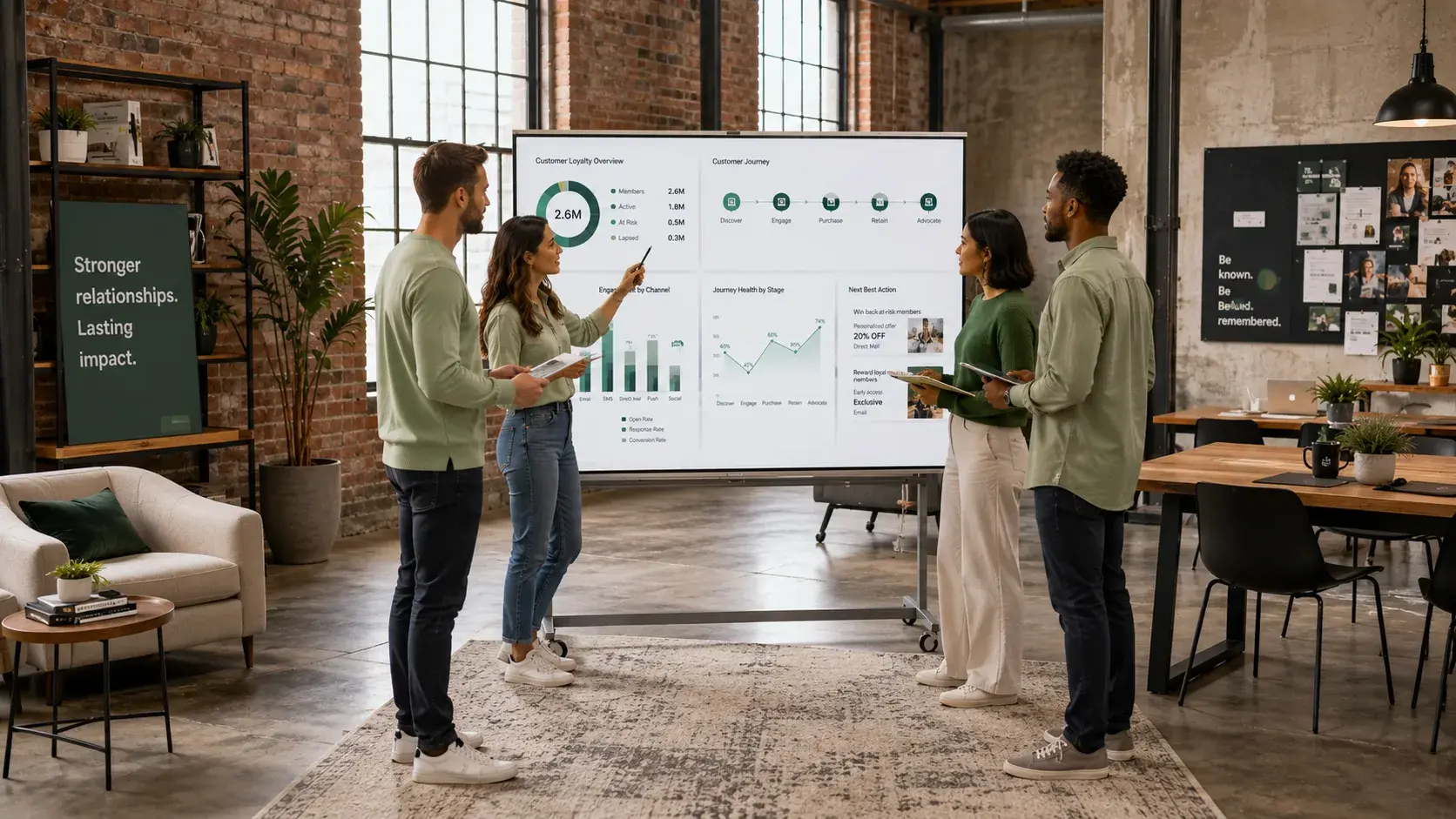
Customer loyalty is a customer’s continued preference for a brand based on trust, relevance, value, and positive experiences over time. It is not created by points alone. Strong customer loyalty comes from personalized customer experiences, consistent engagement, and a clear strategy for keeping customers active across the full customer journey.
Most loyalty programs fail because they focus too much on rewards and not enough on customer behavior. A successful customer loyalty strategy connects data, personalization, lifecycle marketing, analytics, and omnichannel engagement.
TL;DR: What Is Customer Loyalty?
Customer loyalty is the reason customers continue to choose one brand rather than switch to another.
Strong customer loyalty can help brands:
- Increase repeat purchases
- Improve retention
- Grow customer lifetime value
- Reduce churn
- Strengthen customer engagement
- Improve loyalty program performance
- Create more predictable revenue
- Build stronger customer relationships
The strongest loyalty programs are not only rewards programs. They are connected customer retention programs supported by data, personalized messaging, lifecycle marketing, and ongoing optimization.
What Does Customer Loyalty Really Mean?
Customer loyalty means a customer continues to engage with and purchase from a brand because the experience feels valuable, relevant, and worth repeating.
A loyalty program can support that relationship, but it is not the whole relationship.
Customer loyalty is shaped by:
- Product experience
- Brand trust
- Customer service
- Purchase experience
- Rewards and recognition
- Personalized offers
- Relevant messaging
- Omnichannel consistency
- Ease of engagement
The biggest misconception is that loyalty is the same as enrollment. A customer can join a program and still disengage if the experience feels generic or disconnected.
That is why modern customer loyalty strategy needs to focus on behavior, not just membership.
Why Do Most Customer Loyalty Programs Fail?
Most customer loyalty programs fail because they are built around transactions instead of relationships.
Many programs rely on the same pattern:
- Enroll the customer
- Award points
- Send generic offers
- Wait for repeat purchases
That approach may create short-term activity, but it often fails to create lasting loyalty.
Common reasons loyalty programs fail include:
- Generic rewards
- Weak personalization
- Poor customer data usage
- Limited lifecycle marketing
- Disconnected channels
- Low member engagement
- Inconsistent customer experiences
- Lack of loyalty program analytics
- No clear optimization plan
The challenge is not getting customers to sign up. The challenge is keeping them engaged after they join.
A loyalty program should help brands understand customers better, communicate more effectively, and create stronger reasons to return.
Why Is Customer Loyalty Important for Retention?
Customer loyalty is important because retained customers are often more valuable over time than one-time buyers.
Loyal customers are more likely to:
- Buy again
- Engage with marketing messages
- Redeem offers
- Join customer retention programs
- Respond to personalized recommendations
- Participate in rewards program marketing
- Stay active longer
Retention also improves marketing efficiency. When brands understand existing customer behavior, they can focus on the messages, offers, and channels most likely to drive repeat engagement.
This is why repeat customer marketing is central to loyalty. Brands do not build long-term growth only by attracting new shoppers. They build it by giving existing customers more reasons to return.
What Does a Strong Customer Loyalty Strategy Include?
A strong customer loyalty strategy connects customer data, engagement, personalization, and measurement into one coordinated plan.
It should answer several questions:
- Who are the most valuable customers?
- What behaviors indicate loyalty?
- Which customers are at risk of lapsing?
- What rewards or experiences motivate action?
- Which channels drive engagement?
- How is loyalty performance measured?
- How often is the program optimized?
A strong loyalty strategy usually includes:
- Customer segmentation
- Loyalty program personalization
- Customer lifecycle marketing
- Behavioral trigger marketing
- Omnichannel loyalty marketing
- Loyalty program analytics
- Program optimization
- Retention-focused measurement
The goal is not simply to reward purchases. The goal is to create a more relevant customer experience that strengthens long-term engagement.

How Does Loyalty Program Personalization Improve Engagement?
Loyalty program personalization improves engagement by making rewards, offers, and messages more relevant to each customer.
Generic loyalty programs often treat all customers the same. That limits impact because customers have different behaviors, preferences, and motivations.
Personalization can include:
- Offers based on purchase history
- Rewards based on loyalty tier
- Product recommendations
- Birthday or anniversary messaging
- Local store offers
- Re-engagement offers for lapsed customers
- VIP experiences for high-value customers
For example, a frequent accessories shopper may respond to different messaging than a customer who mainly purchases apparel. A newly enrolled member may need education, while a long-time member may need recognition.
Personalized customer experiences help customers feel understood. That relevance can improve engagement, repeat purchase behavior, and long-term loyalty.
How Does Customer Lifecycle Marketing Build Loyalty?
Customer lifecycle marketing builds loyalty by matching communication to each stage of the customer journey.
A first-time buyer, repeat customer, loyalty member, and inactive customer should not all receive the same message.
Customer lifecycle marketing may include:
- Welcome messaging
- Post-purchase follow-up
- Loyalty enrollment prompts
- Reward reminders
- Replenishment messaging
- Product recommendations
- Win-back campaigns
- VIP recognition
The purpose is to guide customers from first purchase to repeat engagement and long-term loyalty.
A lifecycle approach also helps brands avoid over-messaging. Instead of sending every campaign to every customer, brands can communicate based on timing, behavior, and relevance.
For a deeper look at this approach, see Customer Lifecycle Management: Turn First-Time Buyers into Loyal Customers.
What Is Behavioral Trigger Marketing in Loyalty?
Behavioral trigger marketing uses customer actions to determine when and how a brand communicates.
Instead of relying only on scheduled campaigns, brands respond to customer behavior.
Examples of behavioral triggers include:
- First purchase
- Second purchase
- Loyalty enrollment
- Reward redemption
- Cart abandonment
- Product browse behavior
- Inactivity
- Lapsed purchase timing
- Store visit behavior
These triggers help brands deliver messages at more relevant moments.
For example, a customer who has not purchased in 90 days may receive a win-back offer. A customer who just joined a loyalty program may receive education about rewards. A customer close to a reward threshold may receive a reminder to take action.
Behavioral trigger marketing supports data-driven loyalty marketing because it uses customer activity to guide communication.
To understand how automation supports this type of engagement, see Marketing Automation Strategy: How to Scale Customer Engagement.
Why Does Omnichannel Loyalty Marketing Matter?
Omnichannel loyalty marketing matters because customers interact with brands across many touchpoints.
Those touchpoints may include:
- Mobile messaging
- Direct mail
- Ecommerce
- Retail stores
- Loyalty portals
- Customer service
- Paid media
Customers do not separate these channels in their minds. They experience one brand.
A strong omnichannel loyalty strategy keeps messaging, offers, and recognition consistent across the customer experience.
For example, a customer may receive:
- An email announcing a loyalty reward
- A mobile message reminding them to redeem it
- A personalized direct mail piece reinforcing the offer
- A store experience that recognizes their loyalty status
When these channels work together, loyalty feels more connected and easier to act on.
Baesman helps brands coordinate email and mobile messaging(SMS) with direct mail to support more consistent customer engagement.
How Do Loyalty Program Analytics Improve Performance?
Loyalty program analytics help brands understand whether their loyalty strategy is driving meaningful customer behavior.
Enrollment alone does not prove success.
Brands should also measure:
- Active member rate
- Repeat purchase rate
- Purchase frequency
- Offer redemption rate
- Customer lifetime value
- Retention rate
- Churn rate
- Engagement by segment
- Reward usage
- Revenue from loyalty members
These metrics help brands identify what is working and where the program needs improvement.
For example, a program may have strong enrollment but weak active participation. That may signal that rewards are not motivating, messaging is not relevant, or the customer experience is too difficult.
For a deeper measurement framework, see How to Measure Customer Loyalty: Key Metrics That Matter.
Baesman’s customer engagement strategy and analytics services help brands connect customer data, segmentation, campaign measurement, and loyalty performance.
What Does the 2025 State of Customer Loyalty Show?
The 2025 State of Customer Loyalty Report shows that loyalty remains a major priority for brands.
The report page highlights that:
- 64% of brands are planning major loyalty program enhancements or complete overhauls
- 77% are maintaining or growing loyalty investment
- 84% say their loyalty strategies are effective or very effective
- 57% cite platform limitations as a primary roadblock
The takeaway is clear. Brands are not abandoning loyalty. They are trying to make loyalty programs more personalized, measurable, and effective.
That shift reinforces why loyalty program optimization matters. Programs need to evolve as customer expectations, data capabilities, and engagement channels change.
What Can Brands Learn From Baesman’s Work With Kate Spade?
Baesman’s work with Kate Spade shows how customer data can improve growth strategy and customer engagement.
Kate Spade needed a stronger way to understand customer behavior, identify valuable customer types, and support acquisition goals. Baesman helped integrate customer data into an analytics environment, compile customer data sources into a single view, analyze spending behavior, develop acquisition matchback logic, and create a unique testing agenda.
With a segmented prospect strategy in place, Kate Spade exceeded its goals for revenue and brand growth, performing 15% above plan.
The loyalty lesson is important. Customer loyalty depends on knowing who customers are, how they behave, and which experiences are most likely to drive future engagement.
Explore the Kate Spade customer data and analytics case study.
How Can Brands Optimize Customer Loyalty Programs?
Brands can optimize customer loyalty programs by reviewing performance regularly and improving the experience based on customer behavior.
Key optimization areas include:
- Reward structure
- Program tiers
- Personalization rules
- Lifecycle campaigns
- Behavioral triggers
- Channel mix
- Member communications
- Offer timing
- Analytics and reporting
- Customer feedback
Loyalty program optimization should focus on one central question: is the program changing customer behavior?
If the answer is unclear, brands may need better measurement, cleaner customer data, stronger segmentation, or more relevant engagement.
What Does Customer Loyalty Look Like in Retail?
In retail, customer loyalty is built through consistent, relevant experiences before, during, and after purchase.
Retail loyalty strategies often include:
- Rewards program marketing
- Personalized product recommendations
- Store-based offers
- Email and mobile messaging
- Direct mail
- Loyalty tier recognition
- Post-purchase follow-up
- Win-back campaigns
Retail customers have many choices. Loyalty grows when the experience feels easy, personal, and valuable.
Baesman’s retail marketing services help brands connect customer engagement, direct mail, loyalty, analytics, and campaign execution across channels.
What Is the Difference Between Customer Loyalty and a Rewards Program?
Customer loyalty is the customer’s continued preference for a brand. A rewards program is one tool that can support that preference.
| Customer Loyalty | Rewards Program |
| Built through trust and value | Built through structured incentives |
| Measured by repeat behavior | Measured by participation and redemption |
| Involves the full customer experience | Usually tied to member benefits |
| Requires personalization and engagement | Often focused on points or perks |
| Supports long-term retention | Supports loyalty activation |
A rewards program can help, but it cannot carry the entire loyalty strategy on its own.
If the experience is generic, inconvenient, or disconnected, customers may still leave.
Final Takeaway: Customer Loyalty Is Bigger Than a Program
Customer loyalty is not defined by points, discounts, or rewards alone. It is built through trust, relevance, personalized experiences, and consistent engagement across the full customer journey.
The strongest customer loyalty strategies combine:
- Customer data
- Loyalty program personalization
- Customer lifecycle marketing
- Behavioral trigger marketing
- Omnichannel loyalty marketing
- Loyalty program analytics
- Ongoing program optimization
Brands that treat loyalty as a customer strategy, not just a rewards structure, are better positioned to improve retention, increase customer lifetime value, and build stronger long-term relationships.

Frequently Asked Questions About Customer Loyalty
What is customer loyalty?
Customer loyalty is a customer’s ongoing preference for a brand based on trust, relevance, value, and positive experiences. It is shown through repeat purchases, continued engagement, and long-term brand preference.
Why do most loyalty programs fail?
Most loyalty programs fail because they focus too heavily on points and rewards while neglecting personalization, customer data, lifecycle marketing, and ongoing engagement.
What is a customer loyalty strategy?
A customer loyalty strategy is a plan for improving retention, repeat purchases, and customer engagement. It usually includes data, segmentation, personalization, loyalty program analytics, and omnichannel communication.
What is loyalty program personalization?
Loyalty program personalization uses customer data and behavior to deliver more relevant offers, rewards, messages, and experiences. It helps brands make loyalty feel more meaningful to each customer.
How does omnichannel loyalty marketing work?
Omnichannel loyalty marketing connects loyalty communication across channels like email, mobile messaging, direct mail, retail stores, and ecommerce. The goal is to create one consistent customer experience.
How can brands improve customer loyalty?
Brands can improve customer loyalty by using customer data, personalizing engagement, optimizing rewards, measuring program performance, and communicating at key moments in the customer lifecycle.
Ready to Build a Smarter Customer Loyalty Strategy?
Customer loyalty is strongest when data, personalization, analytics, and engagement work together.
