
-
Customer Strategy Services

Customer Analytics & Insights
Turn customer data into clear insights that improve targeting, campaign performance, and measurable growth.

Loyalty Program Design & Management
Build and manage loyalty programs that increase engagement, retention, and customer lifetime value.

CRM Channel Marketing & Management
Coordinate direct mail, email, and SMS strategies that reach the right customers and prove ROI.

Customer Lifecycle Marketing & Journey Mapping
Design connected journeys that move customers from acquisition to retention and repeat purchase.
Print & Marketing Execution

Direct Mail
Execute personalized direct mail campaigns that improve targeting, response rates, and measurable marketing ROI.

Email & SMS Marketing
Deliver timely, data-driven email and SMS campaigns that increase engagement, conversion, and customer retention.

In-Store Signage & All Things Print
Produce and deliver on-brand print, signage, and materials on time across every location.

Web-to-Print
Give teams one platform to order, customize, and control branded materials at scale.

Kitting & Fulfillment
Simplify complex distribution with accurate kitting, inventory control, and on-time delivery.
Branded Merchandise

Promotional Products & Branded Apparel
Curated, brand-right merchandise for campaigns, events, customer engagement, and everyday brand visibility.

Online Company Stores
Branded online stores that simplify ordering, inventory management and distribution across teams and locations.

Custom Kitting & Fulfillment
Custom kit assembly, warehousing, and reliable fulfillment for launches, events, employee programs, and customer campaigns.

Programs Built Around Your Goals
Brand-right merchandise solutions tailored to your audience, objectives, timeline and budget—from product selection through fulfillment.
-
-
-
.svg)
Why Baesman?
We combine data-driven strategy, seamless execution, and personalized support to help brands build more profitable customer relationships.

Data Security & Trust Center
See how Baesman protects customer data with secure processes, compliance standards, and a commitment to transparency.

Awards
Explore the recognition that reflects Baesman’s commitment to innovation, quality, service, and results.

Partners
Discover the technology and strategic partnerships that help Baesman deliver smarter, more connected marketing.

Careers
Join a team that values collaboration, growth, and doing the right thing for clients, teammates, and each other.




7 min read
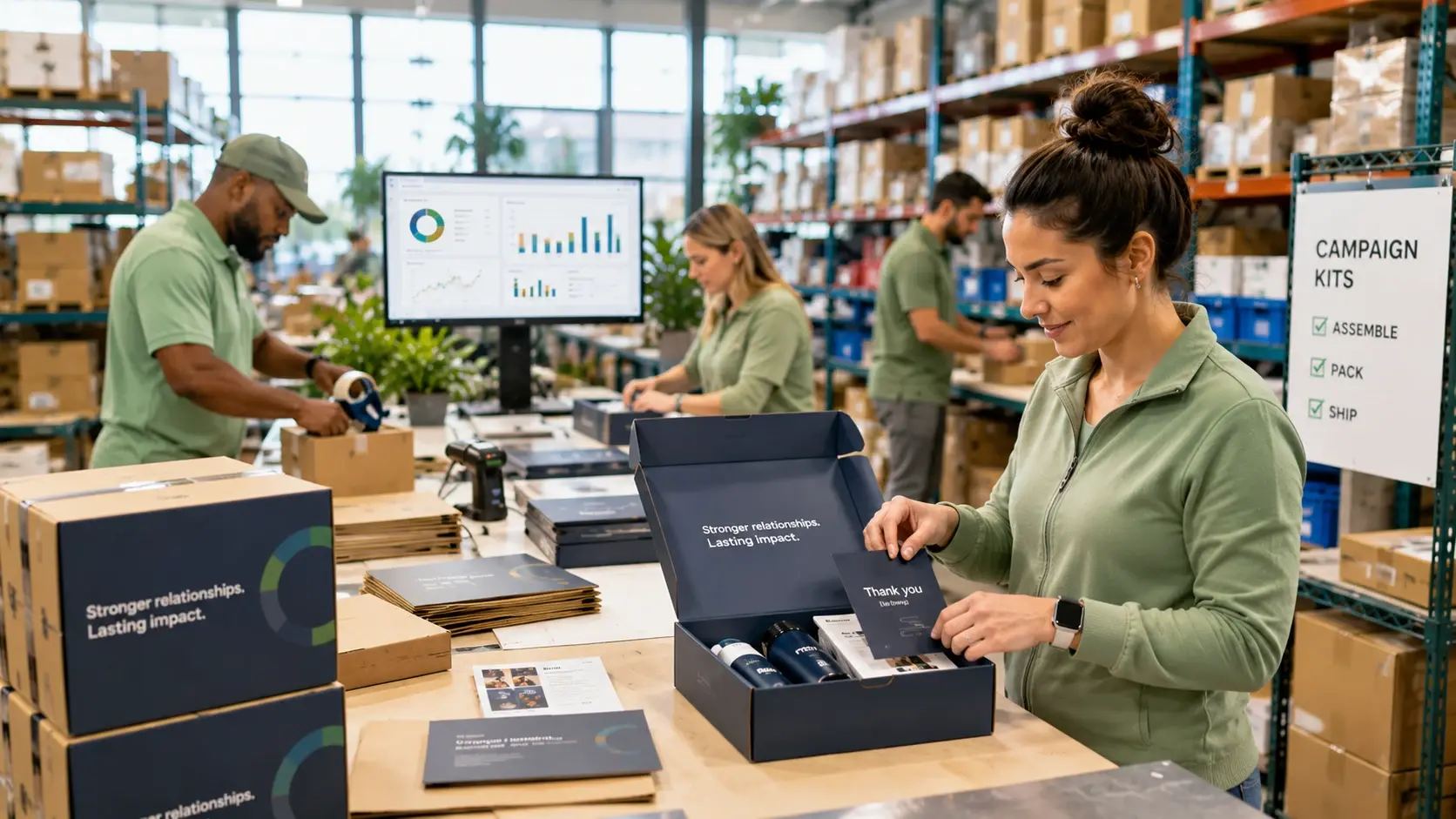
Warehouse kitting service and fulfillment helps brands assemble, store, manage, and distribute marketing materials, branded kits, direct mail, retail assets, and campaign materials at scale. It matters because marketing performance depends not only on strategy and creative, but also on getting the right materials to the right locations at the right time.
A strong fulfillment operation improves speed, accuracy, brand consistency, and campaign execution. For growing brands, it can reduce manual work, support multi-location marketing, and create a more scalable path from planning to delivery.
TL;DR: Why Do Warehouse Kitting and Fulfillment Matter?
Warehouse kitting service and fulfillment matter because they turn marketing plans into organized, repeatable execution.
They help brands:
- Assemble campaign materials accurately
- Store inventory securely
- Ship materials to the right locations
- Improve direct mail fulfillment
- Support branded kit assembly
- Maintain consistency across locations
- Reduce manual marketing operations work
- Improve speed to market
- Scale campaign fulfillment services
The strongest fulfillment strategies connect inventory, kit assembly, ordering, shipping, tracking, and reporting into one coordinated workflow.
What Is Warehouse Kitting Service and Fulfillment?
Warehouse kitting service and fulfillment is the process of storing, assembling, packing, and distributing products or marketing materials from a centralized fulfillment operation.
It often includes:
- Inventory storage
- Product kitting services
- Branded kit assembly
- Packaging
- Order processing
- Shipping
- Direct mail fulfillment
- Multi-location fulfillment
- Reporting and tracking
For marketing teams, fulfillment is not just a back-end shipping function. It is part of campaign execution.
A campaign may be strategically sound, but if materials arrive late, are inconsistent, or go to the wrong location, performance can suffer.
Warehouse fulfillment also plays an important role in broader customer engagement initiatives. Whether supporting direct mail campaigns, loyalty programs, retail marketing, or personalized customer communications, fulfillment helps ensure marketing materials arrive accurately and on time.
Baesman’s fulfillment services help brands manage storage, ordering, packing, shipping, reporting, and marketing asset distribution through a more controlled fulfillment process.
What Is Kitting in Fulfillment?
Kitting in fulfillment is the process of combining multiple items into one ready-to-ship package.
Instead of sending items separately, a fulfillment team assembles related components into a complete kit before distribution.
Common examples include:
- New store opening kits
- Franchise marketing kits
- Retail signage kits
- Loyalty program kits
- Direct mail campaign kits
- Employee onboarding kits
- Event kits
- Promotional product kits
For example, a retail campaign may require window signage, shelf cards, promotional flyers, coupons, and instructions for store teams. Kitting brings those items together so each location receives a complete, organized package.
For a deeper breakdown of terminology, workflows, and common use cases, see What Is Kitting and Fulfillment? A Guide for Marketing and Retail Teams.
What Is the Difference Between Kitting and Fulfillment?
Kitting and fulfillment are related, but they are not the same.
| Kitting | Fulfillment |
| Combines multiple items into one kit | Manages storage, orders, packing, and shipping |
| Prepares materials before delivery | Moves materials to customers, stores, or locations |
| Focuses on assembly and accuracy | Focuses on execution and distribution |
| Supports campaign readiness | Supports campaign delivery |
| Often happens before shipping |
Includes shipping, tracking, and reporting |
Kitting is one step within the larger fulfillment and kitting process. Fulfillment includes the full operational workflow that moves materials from inventory to delivery.
How Does the Fulfillment and Kitting Process Work?
The fulfillment and kitting process usually follows a structured workflow that helps brands manage campaign materials more efficiently.
Step 1: Materials Are Stored and Organized
Marketing materials, printed assets, signage, promotional items, packaging, and product components are stored in a fulfillment center.
Inventory management is important because teams need to know:
- What is available
- Where it is stored
- How much is left
- What needs to be reordered
- Which materials are tied to which campaigns
Without accurate inventory visibility, campaigns can face delays, waste, and inconsistent execution.
Step 2: Kits Are Built Based on Campaign Needs
Once materials are available, fulfillment teams assemble kits based on defined requirements.
A kit may be built by:
- Store location
- Campaign type
- Region
- Customer segment
- Franchise need
- Event schedule
- Product launch
This is where branded kit assembly becomes important. Each package should reflect the right materials, quantities, branding, and instructions.
Step 3: Orders Are Packed and Shipped
After kits are assembled, they are packed and shipped to the correct destination.
That may include:
- Retail stores
- Franchise locations
- Corporate offices
- Customers
- Event venues
- Sales teams
- Distribution partners
The order fulfillment process should include tracking, quality control, and delivery visibility.
Step 4: Reporting Helps Improve Future Campaigns
Strong fulfillment center services provide reporting that helps marketing teams understand inventory levels, order status, shipment activity, and campaign readiness.
Reporting helps brands reduce waste, improve planning, and avoid last-minute execution issues.
Why Do Marketing Teams Use Kitting and Fulfillment Services?
Marketing teams use kitting and fulfillment services because campaigns often involve many moving parts.
A single campaign may include creative assets, printed materials, signage, promotional items, direct mail, packaging, and location-specific versions.
Without a centralized fulfillment process, teams may struggle with:
- Manual ordering
- Inconsistent materials
- Delayed shipments
- Inventory confusion
- Extra shipping costs
- Lack of campaign visibility
- Too much internal coordination
Marketing fulfillment services reduce complexity by managing the operational side of campaign execution.
The goal is not just to ship materials. The goal is to make campaigns easier to launch, manage, and measure.
How Do Marketing Fulfillment Services Support Campaign Performance?
Marketing fulfillment services support campaign performance by improving consistency, timing, and accuracy.
Campaigns often depend on more than strong messaging. They also depend on whether materials are available, correctly assembled, and delivered when needed.
Marketing fulfillment services can support:
- Seasonal campaigns
- Retail promotions
- Direct mail programs
- Loyalty program materials
- Product launches
- New store openings
- Franchise marketing
- Local store marketing
- Event support
For example, a brand launching a retail promotion across hundreds of locations may need every store to receive the correct signage before the campaign starts. Fulfillment helps make that possible.
Marketing fulfillment becomes even more valuable when integrated with customer engagement strategy and analytics. Campaigns perform best when inventory, fulfillment, customer data, and measurement work together rather than operating independently.
How Does Multi-Location Fulfillment Support Retail Brands?
Multi-location fulfillment helps retail brands deliver consistent marketing materials across stores, regions, franchises, or branch locations.
This is especially important when each location needs access to approved assets without creating extra work for corporate teams.
Multi-location fulfillment can help brands:
- Maintain brand consistency
- Support local marketing needs
- Reduce manual requests
- Improve shipping visibility
- Control inventory
- Speed up campaign deployment
- Reduce waste from over-ordering
A strong retail fulfillment strategy helps brands balance local flexibility with centralized control.
What Role Does Direct Mail Fulfillment Play?
Direct mail fulfillment supports the production, preparation, and distribution of direct mail campaigns.
It may include:
- Data processing
- Printing coordination
- Version control
- Personalization
- Mailing preparation
- Postal coordination
- Tracking and reporting
Many brands use direct mail fulfillment as part of a larger omnichannel customer engagement strategy. Direct mail can reinforce email and mobile messaging/text messaging, loyalty communications, and promotional campaigns while providing a tangible customer touchpoint.
Direct mail fulfillment becomes more valuable when it connects to customer data, segmentation, and digital engagement.
For example, a brand may send a personalized direct mail piece to lapsed customers while also using email or mobile messaging to reinforce the same offer.
Baesman’s direct mail services help brands connect print, personalization, mailing, and campaign execution with greater precision.
How Does Web-to-Print Fulfillment Improve Scalability?
Web-to-print fulfillment gives teams access to approved marketing materials through an online ordering portal.
This helps distributed teams order, customize, print, and ship materials without having to submit manual requests each time.
Web-to-print fulfillment can help brands:
- Give locations access to approved templates
- Maintain brand standards
- Enable local customization
- Improve ordering accuracy
- Reduce corporate workload
- Support faster fulfillment
- Track activity through reporting
For multi-location brands, web-to-print fulfillment creates a controlled way to manage local marketing execution at scale.
For a deeper explanation, explore The Ultimate Web-to-Print Guide.

How Can Fulfillment Automation Improve Operations?
Fulfillment automation helps brands improve speed, accuracy, and visibility across the fulfillment process.
Automation may support:
- Inventory updates
- Order routing
- Shipping workflows
- Reorder alerts
- Reporting
- Portal-based ordering
- Shipment tracking
- Quality control
As marketing programs become more personalized and distributed, manual workflows become harder to manage.
Fulfillment automation helps teams reduce errors, improve efficiency, and scale operations without adding unnecessary complexity.
What Can Brands Learn From Baesman's Work With Charley’s?
Baesman’s work with Charley’s shows how fulfillment, web-to-print, and distributed marketing can improve execution for a growing restaurant brand.
Charley’s needed a better way to manage daily marketing collateral for individual restaurants. The existing process required significant corporate involvement, which created delays in response time and delivery.
Baesman developed a secure, brand-aligned print-on-demand portal using its Brandwise storefront solution. The portal enabled restaurant-level on-demand orders while helping Charley’s maintain corporate brand standards.
The solution helped Charley’s:
- Support on-demand marketing orders
- Improve response times and delivery
- Address the unique signage needs of the restaurant
- Reduce signage waste and expenses
- Improve the accuracy of marketing displays
- Reduce corporate administrative burden
The lesson is clear: scalable fulfillment operations can directly improve campaign execution. When locations can access the right materials through a controlled system, brands can move faster while maintaining consistency.
Charley’s example demonstrates why fulfillment should be viewed as a strategic business capability rather than a back-office function. When web-to-print technology, fulfillment operations, inventory management, and campaign execution are connected, brands can scale marketing more efficiently across locations.
Explore the Charley’s web-to-print and fulfillment case study.
How Does Fulfillment Connect to Customer Engagement?
Fulfillment supports customer engagement by helping brands deliver consistent, timely, and relevant experiences.
Operational execution affects what customers see, receive, and experience across channels.
Fulfillment can support:
- Loyalty program materials
- Direct mail campaigns
- Welcome kits
- Store signage
- Promotional kits
- Personalized offers
- Customer communications
Customer engagement often depends on operational execution that customers never see. Loyalty mailings, promotional kits, personalized direct mail, and retention campaigns all require behind-the-scenes fulfillment infrastructure. When fulfillment is connected to customer data and campaign strategy, brands can create more relevant and consistent experiences across channels.
For example, customer loyalty programs may require member communications, rewards materials, direct mail, and personalized messaging. Those experiences depend on reliable operational execution.
When fulfillment connects with email and mobile messaging, direct mail, and customer engagement strategy and analytics, brands can create more coordinated customer experiences.
What Should Brands Look for in a Fulfillment Partner?
Brands should look for a fulfillment partner that can support both operational needs and marketing goals.
Important capabilities include:
- Secure warehousing
- Inventory management
- Product kitting services
- Branded kit assembly
- Direct mail fulfillment
- Web-to-print fulfillment
- Multi-location fulfillment
- Reporting and tracking
- Fulfillment automation
- Scalable campaign fulfillment services
The right partner should help reduce operational friction while supporting brand consistency, campaign speed, and customer experience.
Final Takeaway: Why Does Warehouse Kitting Service and Fulfillment Matter?
Warehouse kitting service and fulfillment matter because marketing execution depends on operational precision.
Strong fulfillment operations help brands assemble materials accurately, manage inventory, support direct mail, distribute kits, serve multiple locations, and scale campaign execution.
For growing brands, fulfillment is not just a logistics function. It is part of the customer experience and part of the marketing performance system.
Frequently Asked Questions About Warehouse Kitting Service and Fulfillment
What is warehouse kitting service and fulfillment?
Warehouse kitting service and fulfillment is the process of storing, assembling, packing, and distributing products or marketing materials from a fulfillment center. It helps brands manage campaign materials, branded kits, direct mail, and multi-location distribution more efficiently.
What is kitting in fulfillment?
Kitting in fulfillment is the process of combining multiple items into one ready-to-ship package. Examples include retail signage kits, direct mail kits, onboarding kits, and promotional product kits.
What is the difference between kitting and fulfillment?
Kitting focuses on assembling multiple items into a complete kit. Fulfillment includes the broader process of inventory management, order processing, packing, shipping, tracking, and reporting.
What are product kitting services?
Product kitting services assemble related products or materials into packaged kits. These services are often used for retail campaigns, branded merchandise, customer welcome kits, event kits, and franchise marketing materials.
What is web-to-print fulfillment?
Web-to-print fulfillment allows teams to order, customize, print, and ship approved marketing materials through an online portal. It helps distributed brands maintain consistency while supporting local marketing needs.
Why is fulfillment automation important?
Fulfillment automation is important because it reduces manual work, improves accuracy, speeds up order processing, and gives brands better visibility into inventory, shipping, and campaign execution.
Ready to Build More Scalable Marketing Operations?
Marketing execution depends on more than strategy and creativity. It depends on the systems, inventory, fulfillment workflows, and reporting needed to deliver campaigns consistently.
Ready to improve fulfillment, direct mail, web-to-print, and multi-location marketing execution? Explore Baesman's fulfillment services to see how inventory management, branded kit assembly, campaign fulfillment services, direct mail fulfillment, and distributed marketing support can help brands scale more efficiently.