





-
Customer Strategy Services

Customer Analytics & Insights
Turn customer data into clear insights that improve targeting, campaign performance, and measurable growth.

Loyalty Program Design & Management
Build and manage loyalty programs that increase engagement, retention, and customer lifetime value.

CRM Channel Marketing & Management
Coordinate direct mail, email, and SMS strategies that reach the right customers and prove ROI.

Customer Lifecycle Marketing & Journey Mapping
Design connected journeys that move customers from acquisition to retention and repeat purchase.
Print & Marketing Execution

Direct Mail
Execute personalized direct mail campaigns that improve targeting, response rates, and measurable marketing ROI.

Email & SMS Marketing
Deliver timely, data-driven email and SMS campaigns that increase engagement, conversion, and customer retention.

In-Store Signage & All Things Print
Produce and deliver on-brand print, signage, and materials on time across every location.

Web-to-Print
Give teams one platform to order, customize, and control branded materials at scale.

Kitting & Fulfillment
Simplify complex distribution with accurate kitting, inventory control, and on-time delivery.
Branded Merchandise

Promotional Products & Branded Apparel
Curated, brand-right merchandise for campaigns, events, customer engagement, and everyday brand visibility.

Online Company Stores
Branded online stores that simplify ordering, inventory management and distribution across teams and locations.

Custom Kitting & Fulfillment
Custom kit assembly, warehousing, and reliable fulfillment for launches, events, employee programs, and customer campaigns.

Programs Built Around Your Goals
Brand-right merchandise solutions tailored to your audience, objectives, timeline and budget—from product selection through fulfillment.
-
-
-

Why Baesman?
We combine data-driven strategy, seamless execution, and personalized support to help brands build more profitable customer relationships.

Data Security & Trust Center
See how Baesman protects customer data with secure processes, compliance standards, and a commitment to transparency.

Awards
Explore the recognition that reflects Baesman’s commitment to innovation, quality, service, and results.

Partners
Discover the technology and strategic partnerships that help Baesman deliver smarter, more connected marketing.

Careers
Join a team that values collaboration, growth, and doing the right thing for clients, teammates, and each other.
6 min read
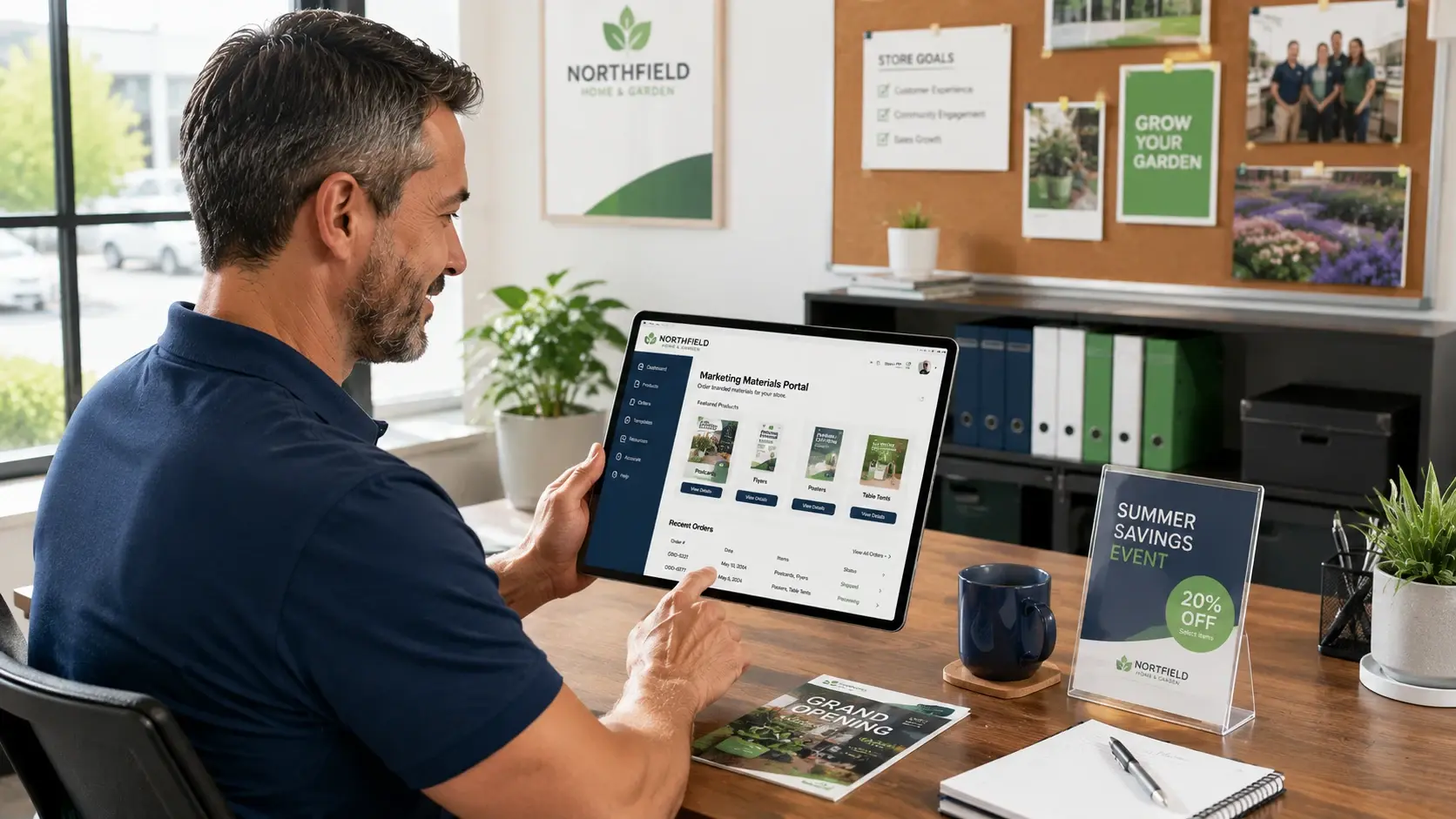
Web-to-print is an online ordering platform that lets individual locations order their own approved marketing materials on demand, while corporate keeps control over brand templates and standards. It solves a specific problem for multi-location brands: how to keep every location on-brand without producing and shipping every single piece from one central team. Done well, it also connects directly to the production and fulfillment work behind it, not just the ordering screen.
TL;DR: The Basics of Web-to-Print
Web-to-print gives locations a self-service portal to order approved, on-brand marketing materials, while corporate maintains template control.
- Locations order what they need without waiting on a central team to produce every piece
- Corporate keeps brand standards locked while still allowing local fields like address or store hours to change
- Web-to-print solutions connect ordering directly to kitting and fulfillment, not just printing
- Baesman's Brandwise platform is built around this exact model for multi-location brands
What Is Web-to-Print?
Web-to-print is a branded, online platform where approved users can order marketing materials, such as signage, direct mail pieces, or in-store collateral, without submitting a request to a central production team each time.
Most web-to-print solutions work the same basic way:
- Corporate uploads approved templates with locked brand elements
- Locations log in and select the material they need
- Local fields, like store address or a location-specific offer, can be edited within set limits
- The order routes automatically to production and fulfillment
This is different from custom web-to-print builds, which are designed around a specific brand's exact catalog and workflow rather than a standard template library.
Why Do Multi-Location Brands Rely on Web-to-Print?
Multi-location brands rely on web-to-print because producing marketing materials centrally for every location does not scale. As a brand grows past a handful of locations, one team trying to design, approve, and ship every piece becomes the bottleneck.
What Happens Without a Self-Service Ordering Portal?
Without a self-service portal, individual locations either wait on a central team for every request or start creating their own materials locally. Both options create problems: waiting slows down time-sensitive local marketing, and local creation leads to inconsistent branding across locations.
For example, a retailer with 50 locations might have each store manager email a request for seasonal signage. During a busy season, that email queue backs up, and some stores end up printing their own signs locally just to keep up, some closer to brand standards than others.
What Changes With a Web-to-Print Portal?
With a web-to-print portal, that same store manager logs in, selects the approved seasonal template, updates the store-specific details, and places the order directly. Corporate never has to manually review each request, and every location works from the same brand-approved starting point.
What Should a Web-to-Print Solution Include?
A strong web-to-print solution needs to support brand control and local speed at the same time.
Does It Include Template and Brand Control?
Template control means locked elements like logos, colors, and required legal language stay fixed, while locations can only edit specific, approved fields. This keeps every order on brand without adding a manual approval step.
Does It Support Local Customization Within Brand Guardrails?
Local customization allows a location to update details like a store address, hours, or a location-specific offer, without touching the elements that need to stay consistent brand-wide. This is what makes the self-service part of web-to-print actually work in practice, rather than just moving the same approval bottleneck online.
Does It Connect to Kitting and Fulfillment?
A web-to-print order does not end at the print file. Kitting and fulfillment services determine how that order actually gets assembled, packaged, and delivered to the right location on time. Retail kitting in particular often combines multiple items, signage, brochures, and promotional materials into a single shipment for a location instead of several separate ones.
Does It Include Online Proofing?
Online proofing lets a location or corporate review exactly what will print before it goes to production, catching errors in a store address or promotional date before materials are printed and shipped rather than after.
How Does Web-to-Print Fit Into Broader Print Production and Fulfillment?
Web-to-print is the ordering layer, not the entire operation behind it. A marketing fulfillment portal needs to connect that ordering step to real production capacity, kitting and fulfillment services, and shipping logistics, or the portal itself becomes just a faster way to create a production backlog.
This is also where web-to-print connects to other channels. A location ordering signage through a portal may also need direct mail for the same promotion, or email and SMS messaging to support it. Baesman's customer engagement strategy and analytics services help brands coordinate that kind of cross-channel execution instead of treating web-to-print as a separate system.
Some of that cross-channel execution touches loyalty program materials as well, such as welcome kits or member-exclusive signage ordered through the same portal a location uses for seasonal promotions. Baesman's Direct Mail Brochure covers how this same coordinated approach extends into personalized direct mail production specifically, pairing centrally produced materials with the same brand standards a web-to-print portal enforces.
Done well, web-to-print fulfillment works best when ordering, production, and delivery are treated as one connected marketing and fulfillment services program rather than three separate vendors handed off between each other.
It is worth noting that this is different from managing a network of independently owned dealers or franchisees, where the challenge is governing partners who do not report to corporate. That scenario is covered in Retail Affiliate Web-to-Print: Managing Brand Consistency Across Partner Networks. Here, the focus is on a brand's own locations.
How Did Cardinal Health Use Web-to-Print to Cut Costs at Scale?
Baesman's work with Cardinal Health shows what web-to-print can do at serious scale. Cardinal Health distributes medical and pharmaceutical products to more than 60,000 locations, and many of those locations needed point-of-sale signage and other printed marketing on an ongoing basis.
Baesman built a web-to-print and digital storefront that gave individual pharmacies direct control over ordering what they needed, when they needed it, including online proofing before anything went to print. The result was a 50% reduction in print and shipping costs compared to traditional phone orders and manual job submissions.
That result did not come from cutting corners on brand standards. It came from replacing a slow, manual ordering process with a self-service system that still kept every order within approved templates. Cardinal Health proves that self-service ordering and cost control are not in tension when the platform is built correctly.
What Should Brands Track to Measure Web-to-Print Performance?
Brands should track metrics that show whether their web-to-print program is actually reducing cost and improving consistency, not just whether locations are using it.
Key metrics include:
- Order turnaround time: how long it takes from order placement to delivery
- Print and shipping cost per order: whether self-service ordering is actually reducing cost compared to manual requests
- Template compliance rate: how often orders stay within approved brand templates
- Portal adoption rate: what percentage of locations are ordering through the portal instead of working around it
- Proofing error catch rate: how often online proofing catches an error before it reaches production
Brands managing high order volume across many locations often pair this kind of tracking with Baesman's kitting and fulfillment services to keep production and delivery moving at the same pace as ordering.
Frequently Asked Questions About Web-to-Print
What is web-to-print?
Web-to-print is an online platform that lets approved users order marketing materials using pre-built, brand-controlled templates, without submitting a custom request to a production team each time.
How is web-to-print different from custom web-to-print?
Standard web-to-print solutions use a template library that works for most brands. Custom web-to-print is built around a specific brand's exact catalog, workflow, and approval process.
Does web-to-print work for franchise businesses?
Yes. Web-to-print for franchisee owners is a common use case, since it lets individual franchise locations order approved materials quickly while corporate maintains brand control.
How does web-to-print connect to fulfillment?
Web-to-print handles ordering, while kitting and fulfillment services handle assembling, packaging, and shipping the finished materials to the right location on time.
Can web-to-print reduce printing costs?
Yes. Moving from manual, phone-based ordering to a self-service web-to-print portal can significantly cut print and shipping costs, as seen in Baesman's work with Cardinal Health.
What should brands look for in a web-to-print solution?
Brands should look for strong template and brand control, local customization within set limits, online proofing, and a direct connection to kitting and fulfillment.
Final Takeaway: Why Web-to-Print Works Best as Part of a Connected System
Web-to-print is not just a faster way to place an order. It is the ordering layer that connects brand control, local speed, and the kitting and fulfillment work that gets materials into the right hands on time.
Brands that treat web-to-print as one piece of a connected production and marketing fulfillment portal, rather than a standalone ordering tool, are the ones that see real cost savings and consistency at scale, the way Cardinal Health did across more than 60,000 locations.
For a closer look at how Baesman helps multi-location brands manage self-service ordering and template control, download the Brandwise brochure.

About the Author