





-
Customer Strategy Services

Customer Analytics & Insights
Turn customer data into clear insights that improve targeting, campaign performance, and measurable growth.

Loyalty Program Design & Management
Build and manage loyalty programs that increase engagement, retention, and customer lifetime value.

CRM Channel Marketing & Management
Coordinate direct mail, email, and SMS strategies that reach the right customers and prove ROI.

Customer Lifecycle Marketing & Journey Mapping
Design connected journeys that move customers from acquisition to retention and repeat purchase.
Print & Marketing Execution

Direct Mail
Execute personalized direct mail campaigns that improve targeting, response rates, and measurable marketing ROI.

Email & SMS Marketing
Deliver timely, data-driven email and SMS campaigns that increase engagement, conversion, and customer retention.

In-Store Signage & All Things Print
Produce and deliver on-brand print, signage, and materials on time across every location.

Web-to-Print
Give teams one platform to order, customize, and control branded materials at scale.

Kitting & Fulfillment
Simplify complex distribution with accurate kitting, inventory control, and on-time delivery.
Branded Merchandise

Promotional Products & Branded Apparel
Curated, brand-right merchandise for campaigns, events, customer engagement, and everyday brand visibility.

Online Company Stores
Branded online stores that simplify ordering, inventory management and distribution across teams and locations.

Custom Kitting & Fulfillment
Custom kit assembly, warehousing, and reliable fulfillment for launches, events, employee programs, and customer campaigns.

Programs Built Around Your Goals
Brand-right merchandise solutions tailored to your audience, objectives, timeline and budget—from product selection through fulfillment.
-
-
-

Why Baesman?
We combine data-driven strategy, seamless execution, and personalized support to help brands build more profitable customer relationships.

Data Security & Trust Center
See how Baesman protects customer data with secure processes, compliance standards, and a commitment to transparency.

Awards
Explore the recognition that reflects Baesman’s commitment to innovation, quality, service, and results.

Partners
Discover the technology and strategic partnerships that help Baesman deliver smarter, more connected marketing.

Careers
Join a team that values collaboration, growth, and doing the right thing for clients, teammates, and each other.
5 min read
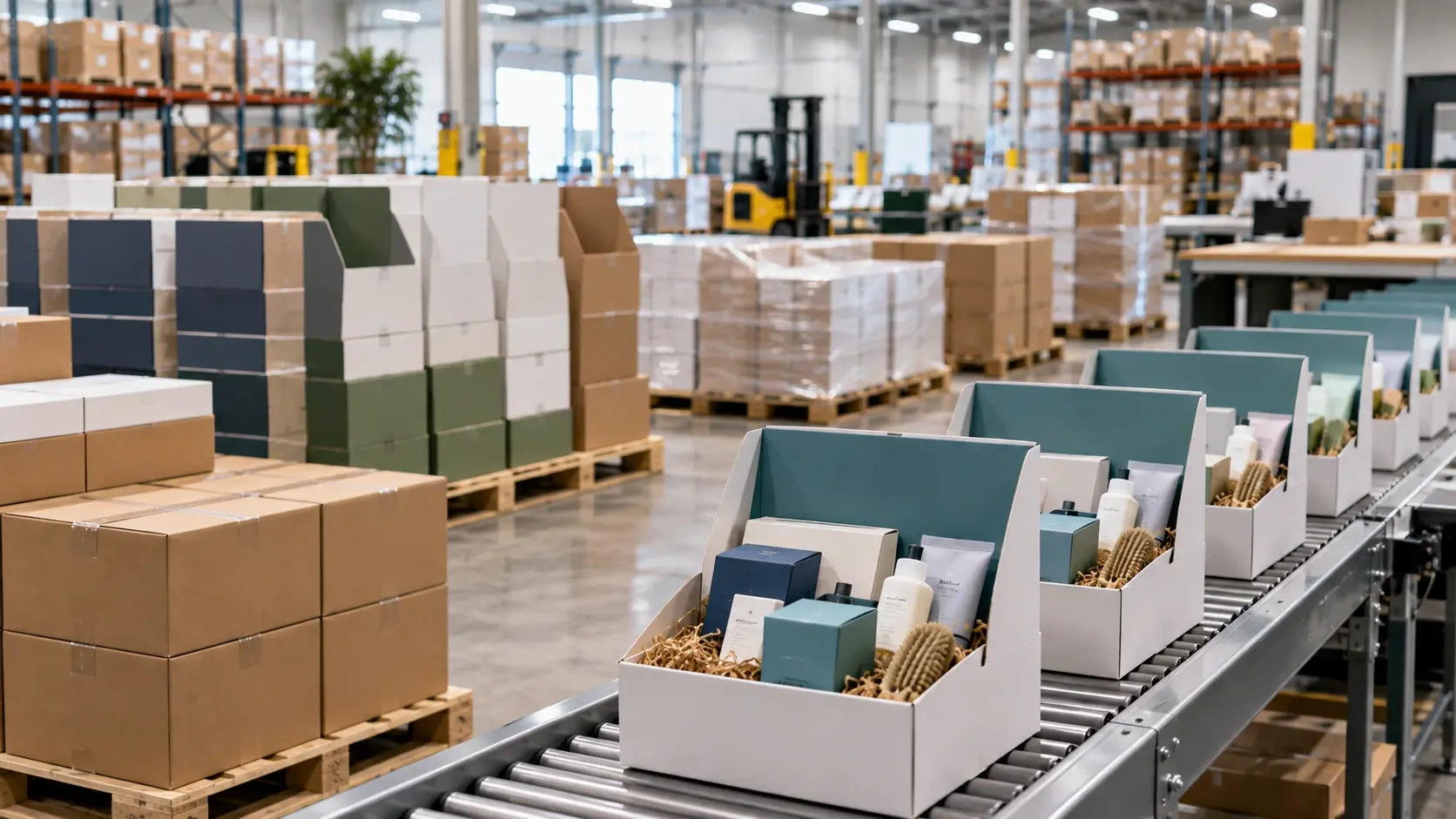
Custom kitting services adapt the contents, personalization, and configuration of a kit to fit a specific campaign, location, or customer segment, instead of shipping the same static kit everywhere. This allows a brand to vary assortments, add personalized elements, and adjust for regional needs while still assembling everything into one coordinated package. For brands running multi-location or highly targeted campaigns, this level of customization has become standard practice rather than a premium upgrade.
TL;DR: What Are Custom Kitting Services?
Custom kitting services adjust what goes inside a kit, and how it is configured, based on campaign, location, or customer needs.
- Custom kitting varies assortments, personalization, and packaging instead of using one fixed kit for every recipient
- Variable data allows names, offers, or messages to be personalized inside a kit, not just on a single printed piece
- Regional and store-level customization lets the same campaign flex to fit different markets
- Complex, multi-location campaigns are where custom kitting delivers the most value
- Baesman's work with a national retailer shows what custom kit packaging can do at scale
What Makes a Kitting Service "Custom"?
A kitting service becomes custom when the contents or configuration of a kit change based on defined variables, rather than every kit being identical.
Standard kitting assembles the same set of items into every package. Custom kitting introduces logic: a rule set that determines what goes into a specific kit based on region, store type, customer segment, or campaign stage.
How Is Custom Kitting Different From Standard Kitting?
Standard kitting works well for a single, uniform rollout, like a product launch where every location receives an identical box. Custom kitting is built for campaigns where recipients need different combinations of materials.
For example, a national retailer opening ten new stores might need nine similar welcome kits and one modified for a flagship location with additional signage. Custom kitting handles both without slowing down the rest of the run.
What Can Be Customized Within a Kit?
Most custom kitting solutions vary along three lines: assortment, personalization, and location.
How Do Brands Customize Kit Assortments?
Assortment customization means changing which items go into a kit based on need. A kit for a high-traffic store might include more signage and a larger promotional display, while a smaller location receives a scaled-down version with the same branding. Retail marketing display kits are a common example, often scaled up for flagship stores and scaled down for smaller footprints within the same campaign.
Common assortment variables include:
- Store size or format
- Product category or seasonal focus
- Campaign stage, such as launch versus ongoing promotion
- Customer tier or loyalty status
How Does Personalization Work Inside a Kit?
Personalization inside a kit typically relies on the same variable data principles used in direct mail. A name, offer, or reference number can be printed on an insert, a card, or packaging itself, so the kit feels built for one recipient even when thousands are produced.
This works well for onboarding kits, loyalty welcome packages, or direct mail programs that pair a printed piece with a physical item.
How Does Regional or Store-Level Customization Work?
Regional customization adjusts a kit's contents based on location-specific factors, such as climate, local promotions, or compliance requirements. A retailer might send different signage to stores in different states, or adjust a seasonal kit's timing based on regional weather patterns.
When Do Complex Campaigns Need Custom Kitting?
Retail kitting needs tend to grow more complex when a single kit design cannot serve every recipient.
Common triggers include:
- Multi-location retail rollouts where store formats vary
- Franchise programs where locations need some materials in common and some unique to their market
- Seasonal promotions that launch at different times across regions
- New store openings that require a modified kit for flagship or high-visibility locations
- Loyalty programs where welcome kits are personalized by member tier
Brands managing this kind of complexity across retail marketing services or a customer loyalty program are the ones most likely to need custom kitting rather than a standard, one-size configuration.
How Did Lane Bryant Use Custom Kit Packaging to Cut Costs?
Baesman's work with Lane Bryant shows what custom kit packaging can do when a fulfillment program is built around variation instead of a single static kit.
Lane Bryant's point-of-purchase program was managed by hand before working with Baesman. Store managers were spending time on sign order requests, and print run quantities, inventory, and waste were all too high.
Baesman built an automated, turnkey Sign Ordering System (SOS) paired with custom kit packaging and kit packing services. The system let each store order only what it needed, enforced store-level limits, and sent low-stock alerts so materials arrived before a shortage became a problem.
The results were significant: a 50% reduction in overall program cost, a nearly 50% reduction in freight and warehousing costs, and a 90% reduction in in-store POP inventory.
"I don't know why any retailer in America wouldn't use Baesman's Sign Ordering System," said Cyndi Boblett, Print Production Director at Lane Bryant. "It gives us the ability to be proactive, to manage a problem before it becomes a problem. You can't put a price tag on that."
That result did not come from a bigger warehouse or more printed material. It came from building the kitting and ordering process around what each store actually needed, the same principle behind any well-designed custom kitting program.
How Should Brands Evaluate a Custom Kitting Services Provider?
Not every fulfillment partner is equipped to handle variable kit configurations at scale.
A strong custom kitting services provider should offer:
- Clear rules for how kits vary by store, region, or segment
- Accurate inventory tracking across every kit variation
- Variable data capability for personalized elements inside a kit
- Low-stock alerts or automated reordering to prevent shortages
- Reporting that shows how each kit configuration is performing
- Warehouse kitting service and fulfillment capacity that scales during peak campaign periods
Brands evaluating providers on this basis can also review Baesman's kitting and fulfillment services directly.
How Does Custom Kitting Connect to a Broader Fulfillment Strategy?
Custom kitting works best as part of a coordinated fulfillment and marketing strategy, not as a standalone service.
A web-to-print platform often sits alongside custom kitting, giving store managers or regional teams a way to order approved, pre-configured kits without needing custom design work each time. For a closer look at how that ordering layer works, see The Ultimate Web-to-Print Guide.
Custom kitting can also extend into broader retail execution and customer engagement strategy and analytics, so kit personalization lines up with what a brand already knows about a customer or location, and into email and SMS messaging when a physical kit is paired with a digital follow-up. Brands looking for a broader view of how kitting and fulfillment operate as a category can also see What Is Kitting and Fulfillment? A Guide for Marketing and Retail Teams, and how customization plays out at the multi-channel campaign level in Custom Kitting and Fulfillment: Simplifying Multi-Channel Marketing Logistics.
What Should Brands Track to Know If Custom Kitting Is Working?
Brands should track whether kit customization is actually reducing waste and improving accuracy, not just whether kits are going out on time.
Key metrics include:
- Inventory reduction: whether custom, on-demand kitting is lowering excess stock compared to a standard kit model
- Freight and warehousing cost: whether variation is being managed efficiently or driving up shipping complexity
- Order accuracy by variation: whether each kit configuration reaches the right location with the right contents
- Reorder frequency: whether low-stock alerts are preventing shortages before they affect a campaign
- Program cost per kit: whether customization is adding cost or removing it through better targeting
Frequently Asked Questions About Custom Kitting Services
What are custom kitting services?
Custom kitting services assemble kits with contents, personalization, or configuration that change based on campaign, location, or customer segment, rather than using one identical kit for every recipient.
How is custom kitting different from standard kitting?
Standard kitting produces the same kit for every recipient. Custom kitting varies assortment, personalization, or configuration based on defined rules, such as store size, region, or customer tier.
Can personalization be included inside a kit, not just on a mailer?
Yes. Variable data can personalize an insert, card, or packaging element within a kit, similar to how it personalizes a direct mail piece.
What kinds of campaigns benefit most from custom kitting?
Multi-location retail rollouts, franchise programs, seasonal promotions with regional timing, and loyalty programs with tiered welcome kits all tend to benefit from custom kitting over a single standard configuration.
Does custom kitting increase costs compared to standard kitting?
Not necessarily. When built around actual store or campaign needs, custom kitting can reduce excess inventory and freight costs, as seen in Baesman's work with Lane Bryant.
What should a brand look for in a custom kitting provider?
Look for clear rules for kit variation, accurate inventory tracking across configurations, variable data capability, automated reordering, and reporting by kit type.
Final Takeaway: Why Custom Kitting Is Now the Standard, Not the Upgrade
Custom kitting services are no longer a premium option layered onto standard fulfillment. For brands running complex, multi-location, or highly targeted campaigns, varying assortment, personalization, and regional configuration is what makes a kitting program actually work.
Brands that build this kind of variation into their fulfillment strategy see measurable results, including stronger inventory control and lower program costs, the same outcomes Lane Bryant achieved by moving to an automated, custom kit packaging approach.
To see how Baesman can build a custom kitting strategy around your specific campaigns and locations, talk to Baesman.

About the Author