
-
Customer Strategy Services

Customer Analytics & Insights
Turn customer data into clear insights that improve targeting, campaign performance, and measurable growth.

Loyalty Program Design & Management
Build and manage loyalty programs that increase engagement, retention, and customer lifetime value.

CRM Channel Marketing & Management
Coordinate direct mail, email, and SMS strategies that reach the right customers and prove ROI.

Customer Lifecycle Marketing & Journey Mapping
Design connected journeys that move customers from acquisition to retention and repeat purchase.
Print & Marketing Execution

Direct Mail
Execute personalized direct mail campaigns that improve targeting, response rates, and measurable marketing ROI.

Email & SMS Marketing
Deliver timely, data-driven email and SMS campaigns that increase engagement, conversion, and customer retention.

In-Store Signage & All Things Print
Produce and deliver on-brand print, signage, and materials on time across every location.

Web-to-Print
Give teams one platform to order, customize, and control branded materials at scale.

Kitting & Fulfillment
Simplify complex distribution with accurate kitting, inventory control, and on-time delivery.
Branded Merchandise

Promotional Products & Branded Apparel
Curated, brand-right merchandise for campaigns, events, customer engagement, and everyday brand visibility.

Online Company Stores
Branded online stores that simplify ordering, inventory management and distribution across teams and locations.

Custom Kitting & Fulfillment
Custom kit assembly, warehousing, and reliable fulfillment for launches, events, employee programs, and customer campaigns.

Programs Built Around Your Goals
Brand-right merchandise solutions tailored to your audience, objectives, timeline and budget—from product selection through fulfillment.
-
-
-
.svg)
Why Baesman?
We combine data-driven strategy, seamless execution, and personalized support to help brands build more profitable customer relationships.

Data Security & Trust Center
See how Baesman protects customer data with secure processes, compliance standards, and a commitment to transparency.

Awards
Explore the recognition that reflects Baesman’s commitment to innovation, quality, service, and results.

Partners
Discover the technology and strategic partnerships that help Baesman deliver smarter, more connected marketing.

Careers
Join a team that values collaboration, growth, and doing the right thing for clients, teammates, and each other.




5 min read
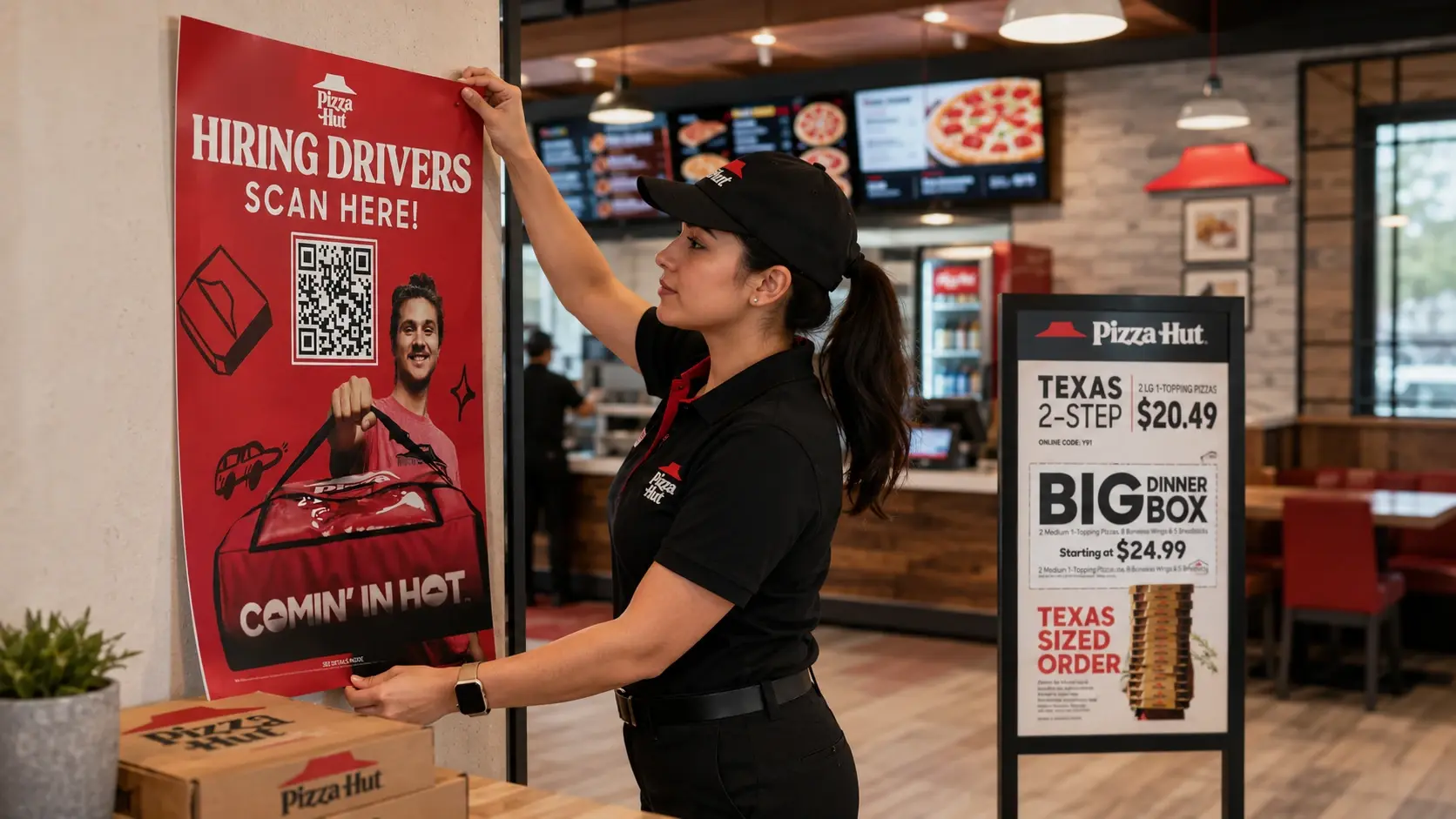
In-store signage connects physical retail space to the rest of a brand's marketing by carrying the same messaging, offers, and visual standards used in direct mail, email, and loyalty campaigns into the store itself. When signage is coordinated with those channels instead of treated as a separate print order, it reinforces the customer experience rather than creating a disconnected moment in the journey.
TL;DR: In-Store Signage and Omnichannel Retail
In-store signage works best when it feels like a continuation of a customer's experience with a brand, not a separate print product managed on its own timeline.
- Signage should carry the same messaging and offers as direct mail, email, and loyalty campaigns
- Disconnected signage creates inconsistent customer experiences across locations
- Centralized fulfillment and web-to-print ordering keep signage current and on-brand in every store
- Signage should be measured like any other marketing channel, not treated as a one-time print job
This builds directly on the operational foundation covered in What Is Kitting and Fulfillment? A Guide for Marketing and Retail Teams.
What Counts as In-Store Signage?
In-store signage includes any printed or displayed material that communicates a message, offer, or brand experience inside a physical retail location.
Common types include:
- Window clings and storefront displays
- Point-of-purchase displays
- Posters and banners
- Shelf talkers and product labels
- Table tents and counter mats
- Wayfinding and directional signage
- Seasonal and promotional signage
For more on why these materials deserve dedicated attention, see Point-of-Purchase Displays: Why Should Retailers Prioritize Them and Audit Your In-Store Signage and Maximize Retail Efficiency.
Why Does In-Store Signage Need to Be Part of an Omnichannel Strategy?
In-store signage needs to be part of an omnichannel strategy because it is often the last touchpoint a customer sees before making a purchase decision, not the first.
By the time a customer walks into a store, they may have already seen an offer through email or mobile messaging, received a related direct mail piece, or engaged with a loyalty program. Signage either reinforces that experience or breaks it.
What Happens When Signage Is Disconnected From Other Channels?
Disconnected signage often shows expired promotions, mismatched offers, or messaging that contradicts what a customer just saw in an email or direct mail piece. Across multiple locations, this creates inconsistent brand experiences that are hard to trace back to a single cause.
For example, a customer who receives a direct mail postcard for a spring promotion may walk into a store still displaying winter signage, undercutting the exact offer they were just sent.
What Happens When Signage Is Coordinated With Other Channels?
Coordinated signage reinforces the same offer, message, and visual identity a customer has already encountered elsewhere. This consistency builds trust, supports higher promotion redemption, and makes the in-store experience feel like a continuation of the relationship rather than a separate interaction.
How Does Fulfillment Support Consistent In-Store Signage Across Locations?
Fulfillment supports consistent in-store signage by making sure every location receives the current, approved version of each piece, on schedule, without relying on individual store managers to track updates manually.
Without centralized fulfillment, it is common for some locations to still display outdated signage while others have already updated to a new campaign. Centralized kitting and fulfillment closes that gap by packaging and distributing signage alongside other campaign materials as one coordinated shipment.
How Does Web-to-Print Keep Signage On-Brand Across Multiple Locations?
Web-to-print keeps signage on-brand by giving every location access to the same approved templates and assets through one centralized ordering system, rather than letting individual stores design or source their own materials.
A web-to-print platform lets store managers or franchise owners order approved signage on demand while corporate marketing controls what can and cannot be changed. For a closer look at how this works in practice, see The Ultimate Web-to-Print Guide.
How Should Brands Coordinate Signage With Direct Mail and Digital Campaigns?
Brands should coordinate signage with direct mail and digital campaigns by building all three around the same creative, offer, and timeline instead of planning them separately.
Practical ways to do this include:
- Using the same creative assets and messaging across signage, direct mail, and email
- Timing signage installation to match direct mail delivery or email send dates
- Adding QR codes to signage that link to a personalized landing page or loyalty sign-up
- Using customer engagement strategy and analytics to measure how in-store and digital touchpoints perform together
When these channels share a calendar and a creative source, signage stops functioning as an afterthought and starts working as part of the same campaign.
How Should Brands Evaluate a Signage and Fulfillment Partner?
Brands working with an outside partner on in-store signage should evaluate them on how well they connect signage to the rest of the marketing program, not just on print quality or price per piece.
When evaluating a partner, ask:
- Does the partner support centralized fulfillment across every location, not just one-off print orders?
- Can they connect signage timing to direct mail, email, and loyalty campaign calendars?
- Do they offer web-to-print ordering so locations can request approved materials without corporate having to manage every request manually?
- Can they report on rollout speed and consistency across locations, not just delivery confirmation?
- Do they understand the operational realities of multi-location or franchise retail?
A partner that treats signage as an isolated print job will eventually create the same consistency gaps a brand is trying to solve. The strongest partners treat signage as one piece of a connected fulfillment and marketing operation, not a separate line item.
How Did Charley's Improve In-Store Consistency With Baesman?
Baesman's work with Charley's shows how centralized signage and fulfillment support consistency across a growing franchise footprint.
As Charley's expanded across more locations, keeping signage, promotional materials, and brand standards consistent became more operationally complex. Rather than leaving each location to manage its own materials, the program connected fulfillment, marketing distribution, and brand consistency into one coordinated system.
That kind of centralized approach is especially valuable for growing franchise brands, where new locations open on different timelines and corporate marketing needs a reliable way to get every store the same materials without managing each request by hand.
The result is a model other multi-location and franchise brands can apply: when signage, fulfillment, and marketing distribution run through the same system, stores get what they need on schedule without sacrificing brand standards.
What Should Brands Track to Measure In-Store Signage Performance?
Brands should track a small set of metrics that show whether signage is actually reinforcing the rest of their marketing, not just whether it was printed and shipped.
Useful metrics include:
- Rollout speed: how long it takes a new campaign to reach every location
- Consistency rate: the percentage of locations displaying current, approved signage at any given time
- Redemption rate: how often signage-driven offers are used relative to other channels
- QR or code scan rate: how often in-store signage drives customers to a digital touchpoint
- Sales lift: change in sales during a signage-supported campaign window compared to baseline
Tracking print and shipping alone, without measuring rollout speed or consistency across locations, is a common reason brands underestimate how much signage is actually costing them in missed consistency. A brand that cannot answer how many locations are currently displaying an outdated promotion has a visibility gap, not just a fulfillment one.

Frequently Asked Questions About In-Store Signage
What is in-store signage?
In-store signage is any printed or displayed material used inside a retail location to communicate a message, offer, or brand experience, including window clings, posters, shelf talkers, and point-of-purchase displays.
Why does in-store signage need to connect to other marketing channels?
Because it is often the last touchpoint before a purchase decision. If signage contradicts or ignores what a customer already saw in email or direct mail, it weakens the experience instead of reinforcing it.
How can brands keep signage consistent across many locations?
By using centralized fulfillment and web-to-print ordering, so every location works from the same approved templates and receives updated materials on the same schedule.
What is the difference between in-store signage and point-of-purchase displays?
Point-of-purchase displays are a specific type of in-store signage placed near the point of decision or checkout. In-store signage is the broader category that also includes window displays, banners, and wayfinding materials.
How does fulfillment support in-store signage programs?
Fulfillment ensures every location receives the current, approved version of signage on schedule, often as part of the same shipment as other campaign materials.
Can in-store signage be measured like other marketing channels?
Yes. Brands can track rollout speed, consistency across locations, redemption rate, and digital engagement driven by in-store signage, such as QR code scans.
Final Takeaway: Why In-Store Signage Belongs in an Omnichannel Strategy
In-store signage is often managed as a separate print task, but it functions as a customer touchpoint just like email, direct mail, or a loyalty program. When it is disconnected from those channels, it creates inconsistency. When it is coordinated with them, it reinforces the experience a customer already expects.
Brands managing signage across multiple locations get the most value when fulfillment, web-to-print ordering, and campaign timing all work from the same system, so every store reflects the same brand standards without slowing down local execution.
Talk to Baesman about connecting in-store signage to your broader marketing and fulfillment strategy.
