





-
Customer Strategy Services

Customer Analytics & Insights
Turn customer data into clear insights that improve targeting, campaign performance, and measurable growth.

Loyalty Program Design & Management
Build and manage loyalty programs that increase engagement, retention, and customer lifetime value.

CRM Channel Marketing & Management
Coordinate direct mail, email, and SMS strategies that reach the right customers and prove ROI.

Customer Lifecycle Marketing & Journey Mapping
Design connected journeys that move customers from acquisition to retention and repeat purchase.
Print & Marketing Execution

Direct Mail
Execute personalized direct mail campaigns that improve targeting, response rates, and measurable marketing ROI.

Email & SMS Marketing
Deliver timely, data-driven email and SMS campaigns that increase engagement, conversion, and customer retention.

In-Store Signage & All Things Print
Produce and deliver on-brand print, signage, and materials on time across every location.

Web-to-Print
Give teams one platform to order, customize, and control branded materials at scale.

Kitting & Fulfillment
Simplify complex distribution with accurate kitting, inventory control, and on-time delivery.
Branded Merchandise

Promotional Products & Branded Apparel
Curated, brand-right merchandise for campaigns, events, customer engagement, and everyday brand visibility.

Online Company Stores
Branded online stores that simplify ordering, inventory management and distribution across teams and locations.

Custom Kitting & Fulfillment
Custom kit assembly, warehousing, and reliable fulfillment for launches, events, employee programs, and customer campaigns.

Programs Built Around Your Goals
Brand-right merchandise solutions tailored to your audience, objectives, timeline and budget—from product selection through fulfillment.
-
-
-

Why Baesman?
We combine data-driven strategy, seamless execution, and personalized support to help brands build more profitable customer relationships.

Data Security & Trust Center
See how Baesman protects customer data with secure processes, compliance standards, and a commitment to transparency.

Awards
Explore the recognition that reflects Baesman’s commitment to innovation, quality, service, and results.

Partners
Discover the technology and strategic partnerships that help Baesman deliver smarter, more connected marketing.

Careers
Join a team that values collaboration, growth, and doing the right thing for clients, teammates, and each other.
5 min read
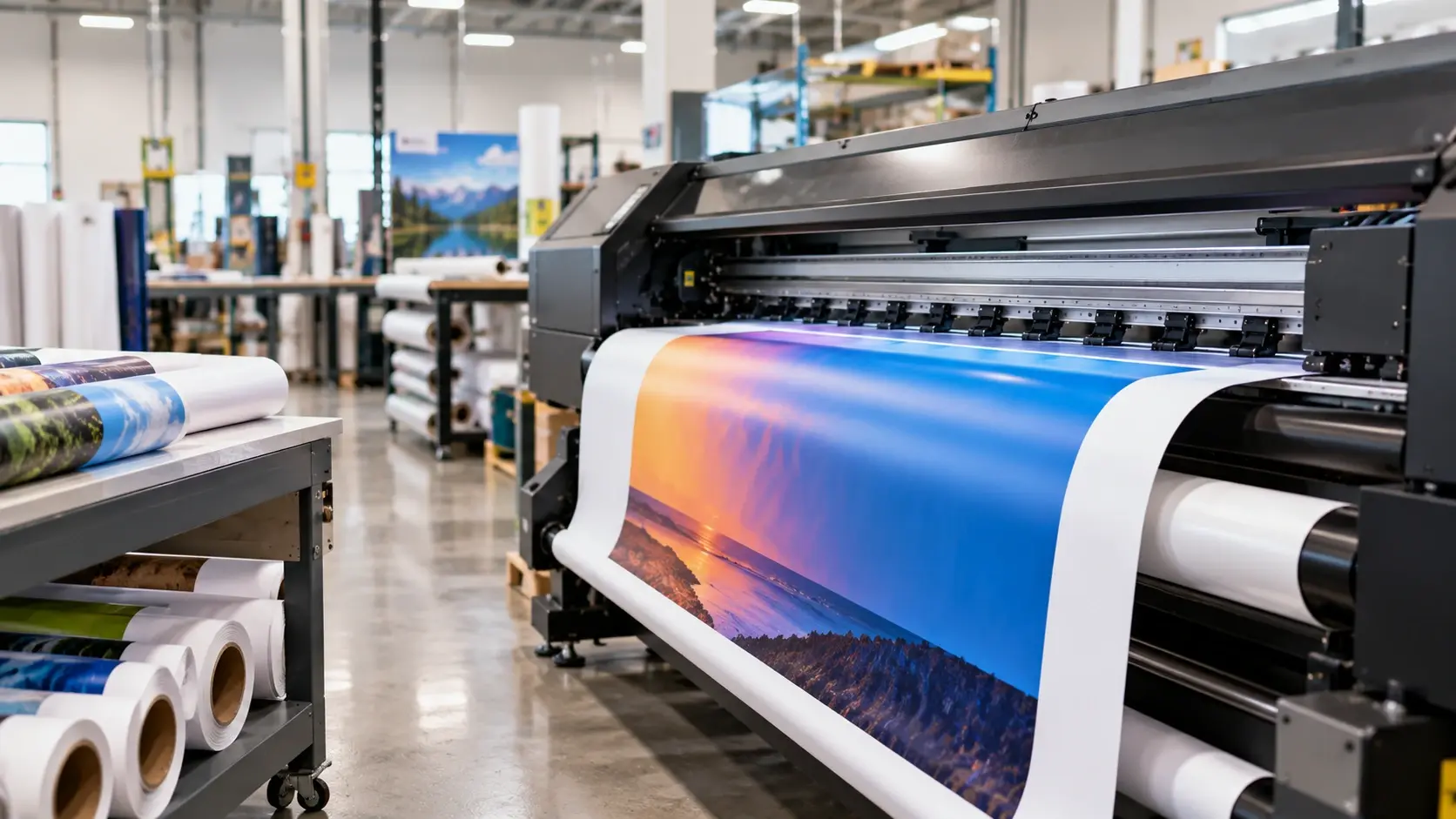
Wide format printing that holds up in the field depends on matching the material and ink to how long a piece actually needs to perform, not just how it looks on day one. Banners, point-of-purchase displays, and window graphics each face different wear, light exposure, and handling, so a single default material rarely works for all three. Getting this right is what keeps signage looking consistent and on-brand across every location, for as long as it needs to.
TL;DR: What Makes Wide-Format Printing Hold Up?
Wide-format printing works when the material, ink, and production process match how long and where a piece needs to perform.
- Material choice matters more than design for how long signage actually holds up
- Traditional materials like PVC are increasingly being replaced by more durable substrates that resist fading and adhesive failure
- Banners, point-of-purchase displays, and window graphics each need different materials based on their environment
- Faster, more automated production reduces reprint waste and gets signage into stores on schedule
- Baesman's work with a national restaurant chain shows what a well-built signage production system can do at scale
What Is Wide-Format Printing?
Wide-format printing produces large printed pieces, typically anything wider than standard office paper, using printers built to handle oversized materials like vinyl, fabric, and rigid board.
It covers a wide range of retail and marketing materials, including:
- Banners and hanging signage
- Point-of-purchase (POP) displays
- Window graphics and clings
- Retail signage and floor graphics
- Event and trade show materials
A wide format printer can produce any of these, but the material behind the print matters as much as the printer itself. A wide format laser printer works well for shorter, lower-volume runs, while UV and latex systems tend to handle higher-volume, more durable production better.
What Determines Whether Wide-Format Signage Holds Up Over Time?
Signage durability comes down to whether the material and ink were chosen for the actual conditions the piece will face, not just for cost or turnaround speed.
Why Does Material Choice Matter More Than Design?
A well-designed piece printed on the wrong material can fade, peel, or yellow within weeks, regardless of how strong the creative is. Window graphics facing direct sunlight, floor graphics facing foot traffic, and hanging banners facing wind all need materials suited to that specific stress, not a one-size material applied everywhere.
What Is Happening With Traditional PVC Signage Materials?
Traditional PVC, long the default for retail signage, is increasingly being phased out in favor of more durable substrates. PVC signage is prone to yellowing and adhesive breakdown over time, especially with UV exposure, which is pushing more brands toward rigid, UV-resistant materials that hold color and adhesion longer in the field.
How Do Banners, POP Displays, and Window Graphics Differ in What They Need?
Not every wide-format piece needs the same material or finish.
Common differences include:
- Banners: need weather resistance and reinforced edges for outdoor or event use
- POP displays: need rigid, stable materials that stand up to repeated handling in-store
- Window graphics: need adhesives and films that will not damage glass or leave residue on removal
- Floor graphics: need slip-resistant, high-durability laminates for foot traffic
A brand that treats all four the same way is likely paying for materials that are either overbuilt for the job or too fragile to last. Custom retail signage solutions typically account for these differences by matching material, finish, and mounting to each specific use case rather than applying one standard to every order.
Why Does Turnaround Time Matter as Much as Durability?
Durability keeps signage looking right after it ships. Turnaround determines whether it arrives in time to matter.
A campaign or event that launches with signage still in production has already lost value, no matter how well the final piece holds up. Automated production processes help reduce this risk by catching errors before a piece prints, which cuts down on reprint waste and the delays that come with it.
This matters most for brands managing many locations at once, where a delay at one point in production can throw off launch timing across an entire region.
How Did Charley's Solve Inconsistent In-Store Signage Production?
Baesman's work with Charley's shows what happens when signage production is built around consistency and speed instead of being handled location by location.
Charley's needed a better way to manage daily marketing signage across its restaurant locations. The existing process relied heavily on corporate staff to review and send materials, which slowed response time and delayed delivery to individual restaurants.
Baesman built a 100% turnkey print-on-demand signage portal using its Brandwise storefront, secure and aligned to corporate branding standards, that let each restaurant order signage on demand without waiting on a corporate request to work its way through the queue. The result was faster response times, more accurate signage for each restaurant's specific configuration, and reduced production waste and expense.
That outcome did not come from a bigger print run. It came from giving every location the right signage, built to its specific needs, without slowing down the rest of the system.
How Should Brands Evaluate a Wide-Format Printing Partner?
Not every wide-format printer, pop display manufacturer, or print shop is built to support signage across many locations. The best wide-format printer for a single event banner is not necessarily the right partner for an ongoing, multi-location signage program.
A strong wide-format printing partner should offer:
- Material recommendations based on where and how long a piece will be used
- Consistent quality across banners, POP displays, and window graphics
- Fast, automated production that reduces errors and reprint waste
- On-demand ordering so individual locations are not waiting on a corporate queue
- Experience producing branded in-store signage for retailers at scale
Brands comparing wide format printing services or pop display companies on price or turnaround alone often miss whether the partner can actually support consistent quality once volume increases.
How Does Wide-Format Signage Connect to the Rest of a Brand's Marketing?
Signage rarely works well in isolation. It performs best when it reinforces the same offer a customer is already seeing elsewhere.
For example, a customer who receives a personalized direct mail offer should see that same promotion reflected in-store, not a mismatched or outdated display. Baesman's direct mail and email and SMS services are often coordinated with signage timing for exactly this reason, and Variable Data Printing: The Secret Behind Personalized Direct Mail goes deeper into how that kind of personalization works on the direct mail side specifically.
Retail signage management also connects to broader retail marketing services and customer engagement strategy and analytics, so in-store materials stay aligned with loyalty promotions and campaign timing rather than running on a separate schedule. For a broader view of how personalization and print production trends are shifting, see Baesman's Direct Mail Trends Infographic.
What Should Brands Track to Know If a Signage Program Is Working?
Brands should track whether in store signage is actually holding up and shipping on time, not just whether it looks good when it first arrives.
Key metrics include:
- Material failure rate: how often signage fades, peels, or fails before its expected lifespan
- Turnaround time: how quickly signage moves from order to delivery
- Reprint rate: how often errors require a piece to be reproduced
- Consistency across locations: whether every location receives accurate, on-brand materials
- Cost per unit over time: whether a cheaper material is actually costing more through early replacement
Frequently Asked Questions About Wide-Format Printing
What is wide-format printing?
Wide-format printing produces large printed materials, such as banners, POP displays, and window graphics, using printers designed to handle oversized substrates like vinyl, fabric, and rigid board.
What is the best material for outdoor banners?
Outdoor banners generally need weather-resistant, reinforced materials that can withstand wind, moisture, and UV exposure without fading quickly.
Why is PVC signage material becoming less common?
PVC is prone to yellowing and adhesive breakdown over time, especially with UV exposure, which is pushing more brands toward more durable, UV-resistant substrates.
How is a POP display different from a banner in terms of materials?
POP displays need rigid, stable materials that can withstand repeated handling in-store, while banners prioritize flexibility and weather resistance.
Does faster turnaround affect signage quality?
Not when production is automated correctly. Automated processes catch errors before printing, which reduces reprint waste and speeds up delivery without sacrificing quality.
What should brands look for in a wide-format printing partner?
Brands should look for material expertise suited to each signage type, consistent quality across locations, fast and automated production, and on-demand ordering support.
Final Takeaway: Why Material and Turnaround Decide Signage Performance
Wide-format printing performance is not decided by the printer alone. It comes down to whether the material matches how and where a piece will be used, and whether production is fast enough to get it there on time.
Brands that treat material selection and turnaround as seriously as design see signage that holds up longer and arrives on schedule- the same outcome Charley's achieved by rebuilding how its restaurant locations ordered and received signage.

To see how Baesman can help build a wide-format printing and signage program built to last, talk to Baesman.
About the Author