





-
Customer Strategy Services

Customer Analytics & Insights
Turn customer data into clear insights that improve targeting, campaign performance, and measurable growth.

Loyalty Program Design & Management
Build and manage loyalty programs that increase engagement, retention, and customer lifetime value.

CRM Channel Marketing & Management
Coordinate direct mail, email, and SMS strategies that reach the right customers and prove ROI.

Customer Lifecycle Marketing & Journey Mapping
Design connected journeys that move customers from acquisition to retention and repeat purchase.
Print & Marketing Execution

Direct Mail
Execute personalized direct mail campaigns that improve targeting, response rates, and measurable marketing ROI.

Email & SMS Marketing
Deliver timely, data-driven email and SMS campaigns that increase engagement, conversion, and customer retention.

In-Store Signage & All Things Print
Produce and deliver on-brand print, signage, and materials on time across every location.

Web-to-Print
Give teams one platform to order, customize, and control branded materials at scale.

Kitting & Fulfillment
Simplify complex distribution with accurate kitting, inventory control, and on-time delivery.
Branded Merchandise

Promotional Products & Branded Apparel
Curated, brand-right merchandise for campaigns, events, customer engagement, and everyday brand visibility.

Online Company Stores
Branded online stores that simplify ordering, inventory management and distribution across teams and locations.

Custom Kitting & Fulfillment
Custom kit assembly, warehousing, and reliable fulfillment for launches, events, employee programs, and customer campaigns.

Programs Built Around Your Goals
Brand-right merchandise solutions tailored to your audience, objectives, timeline and budget—from product selection through fulfillment.
-
-
-
.svg)
Why Baesman?
We combine data-driven strategy, seamless execution, and personalized support to help brands build more profitable customer relationships.

Data Security & Trust Center
See how Baesman protects customer data with secure processes, compliance standards, and a commitment to transparency.

Awards
Explore the recognition that reflects Baesman’s commitment to innovation, quality, service, and results.

Partners
Discover the technology and strategic partnerships that help Baesman deliver smarter, more connected marketing.

Careers
Join a team that values collaboration, growth, and doing the right thing for clients, teammates, and each other.
6 min read
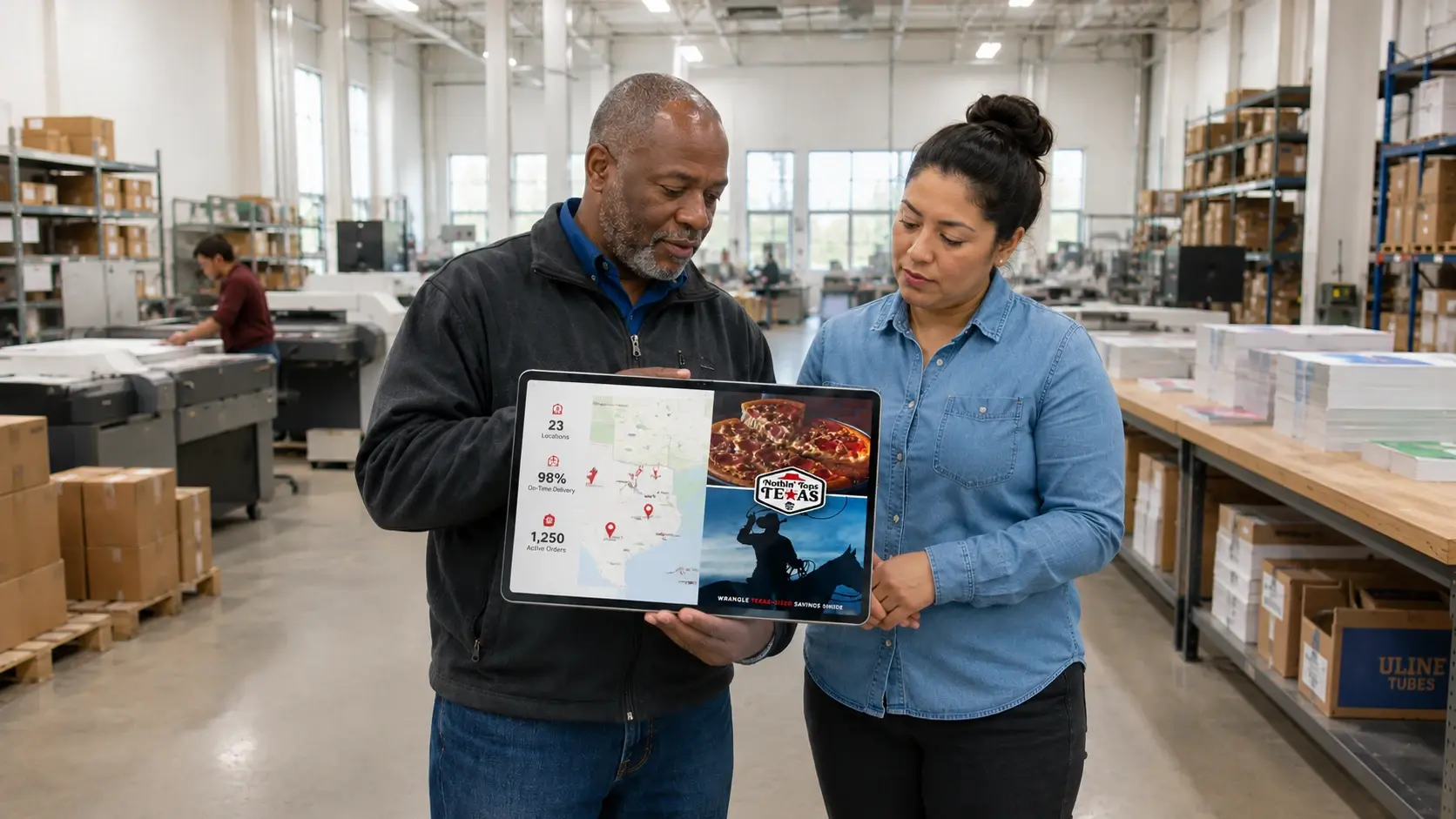
A custom web-to-print platform is a print ordering and fulfillment system built around a specific brand's templates, approval process, and production requirements, rather than a generic web-to-print tool adapted after the fact. Multi-location and franchise brands typically reach this point once off-the-shelf software can no longer keep pace with their template governance, production integration, or fulfillment needs. The right platform connects ordering, production, and distribution into one system instead of a series of workarounds.
TL;DR: Custom Web-to-Print vs. Off-the-Shelf Software
Off-the-shelf web-to-print tools work well for simple ordering, but they often stop working once a brand scales across many locations. A custom platform is built around a brand's own workflow, templates, and production needs instead of a one-size-fits-all system.
Signs a brand has outgrown off-the-shelf software include:
-
Rigid templates that require constant workarounds
-
No direct connection between ordering and production
-
Limited reporting on spend, usage, or inventory
-
Inconsistent brand execution across locations
-
Slow, manual approval processes
A custom platform should include a branded private ordering portal, template governance, workflow automation, integrated production, and flexible fulfillment. For a related read on evaluating print partners, see 4 Considerations When Choosing a Direct Mail Solution.
What Is a Custom Web-to-Print Platform?
A custom web-to-print platform is a private, branded system designed around one brand's specific templates, approval rules, and production process, rather than software built to serve many businesses in similar ways.
Because it is configured around how a specific brand actually operates, including its locations, its approval chain, its production partners, and its fulfillment requirements, it can flex with the brand instead of the other way around.
For brands managing marketing execution across franchise, retail, dealer, or multi-location networks, that difference becomes more important as the business scales.
How Is a Custom Platform Different From Off-the-Shelf Print Software?
Off-the-shelf platforms are designed to work for many types of businesses right out of the box. That makes them fast to set up, but it also means brands often adjust their own process to fit the software rather than the other way around.
A custom platform reverses that relationship. Instead of forcing a brand into a fixed set of features, it is built around the brand's actual workflow, including:
-
How templates are approved and locked
-
How orders move into production
-
How materials are packed, shipped, and tracked
-
How usage and spend are reported back to marketing and finance teams
What Are the Signs a Brand Has Outgrown Off-the-Shelf Web-to-Print Software?
Most brands start with a simpler platform, and that is often the right call early on. The signs it is time to reconsider usually show up as friction rather than outright failure, similar to what we've seen with brands that feel like they've become their own fulfillment company instead of focusing on their core business.
Common signs include:
-
Local teams are working around templates instead of using them as built
-
Marketing and production live in separate systems that do not talk to each other
-
Orders take longer to fulfill because of manual handoffs between ordering and print
-
Leadership has little visibility into what is being ordered, printed, or spent across locations
-
Support requests take too long to resolve because the platform is not built for the brand's specific setup
Any one of these on its own may not be urgent. Several together usually mean the platform is limiting growth rather than supporting it.
What Should a Custom Web-to-Print Platform Include?
A strong custom platform combines ordering control, production integration, and fulfillment into one connected system.
Does It Provide a Branded, Private Ordering Portal?
A private print portal should look and feel like the brand itself, not like third-party software. This builds trust with the local teams using it and keeps the ordering experience consistent with everything else the brand controls.
Does It Include Template Governance?
Template governance means the platform controls what can and cannot be changed. Local users can update fields like address, offer, or event date, while logos, colors, layouts, and required legal language stay locked in place.
Does It Support Workflow Automation?
Workflow automation removes manual steps from the ordering and approval process. Orders route to the right approver automatically, and approved orders move into production without someone re-entering the request by hand.
Is Production Integrated Into the Platform?
Print production integration means an order does not have to leave the platform to get printed. Ordering, proofing, and production run through the same connected system, which reduces errors and shortens turnaround time. This is closely tied to fulfillment execution, covered in more detail in Beyond Printing: Fulfillment and Distribution Center Solutions.
Does It Offer Fulfillment and Shipping Flexibility for Print Orders?
A location may need one hundred pieces shipped overnight, while another needs a scheduled monthly delivery. A custom platform should support both without requiring a separate vendor or a separate process, the same way kitting and fulfillment programs are built to flex around order size and timing.
How Does This Apply to Franchise and Multi-Location Brands?
Franchise operations present a specific version of this challenge: corporate teams need to protect brand standards, while individual locations need the flexibility to execute local marketing quickly.
A custom web-to-print platform gives franchise owners and store managers a single place to order approved materials, from direct mail to in-store signage, while giving corporate marketing full visibility into what is being ordered, printed, and spent across the entire network. The same model applies to retail marketing execution more broadly, wherever a brand needs consistent execution across many storefronts.
How Did Rag & Bone Benefit From This Approach?
Baesman's work with Rag & Bone shows what this looks like in practice. As the brand's retail footprint grew, so did the complexity of getting the right marketing materials to the right locations, on brand and on schedule.
Rather than adapting a generic platform to fit that need, the program was built around how Rag & Bone's stores actually operate: their approval process, their production requirements, and their fulfillment timelines. The result is a system that supports brand consistency without slowing down local execution, which is the core tradeoff a custom platform is meant to solve.
How Should Brands Compare Custom vs. Off-the-Shelf Web-to-Print Platforms?
The comparison should focus on operational fit, not just feature lists, in much the same way we've encouraged brands to think about choosing between platforms and partners in other parts of their marketing stack. When evaluating a custom versus an off-the-shelf approach, ask:
-
Does the platform match how our brand already approves and produces materials, or would we need to change our process to fit the software?
-
Is production connected to ordering, or is it a separate manual step?
-
Can fulfillment flex by location, order size, and timeline?
-
Does reporting show real usage, spend, and inventory across every location?
-
Is support built around our specific setup, or a general help desk?
A generic platform can look capable during initial setup. The real test is whether it holds up across dozens or hundreds of locations placing real orders every week. That same question has come up as brands weigh working with an agency versus building the capability internally: the right answer depends on operational fit, not just upfront cost.
How Does Web-to-Print Fit Into Broader Marketing Execution?
Print ordering does not operate in isolation. Brands that manage web-to-print well typically connect it to their broader customer engagement strategy, including direct mail, email and SMS marketing, and customer loyalty programs.
For example, a location might use a custom platform to order a personalized direct mail campaign, track its production through the same system, and measure performance alongside email and loyalty touchpoints. Baesman's customer engagement strategy and analytics services help brands connect that kind of cross-channel measurement.
For a closer look at Baesman's own platform, see the Brandwise brochure, and download the Variable Direct Mail Brochure for more on personalized print execution.
Frequently Asked Questions About Custom Web-to-Print Platforms
What is a custom web-to-print platform?
A custom web-to-print platform is a private, branded print ordering and fulfillment system built around a specific brand's templates, approval process, and production needs, rather than a generic tool used by many businesses.
How is a custom platform different from off-the-shelf print software?
Off-the-shelf software asks a brand to adapt its process to the tool. A custom platform is built around the brand's existing workflow, including approvals, production, and fulfillment.
When does a brand need a custom web-to-print platform instead of off-the-shelf software?
Usually once a brand has enough locations, templates, or order volume that manual workarounds, disconnected production, or limited reporting start slowing down execution.
Can a custom web-to-print platform support franchise networks?
Yes. A custom platform lets corporate teams maintain brand standards while giving franchise owners and store managers a fast, self-service way to order approved materials.
Does a custom platform cost more than off-the-shelf software?
It depends on the provider and the brand's needs. The more useful comparison is total operational cost, including manual labor, production delays, and brand inconsistency, not just the software price.
What should brands look for when comparing platforms?
Look for template governance, workflow automation, integrated production, flexible fulfillment, and reporting that covers every location, not just the platform's feature list.
Final Takeaway: Why Custom Web-to-Print Matters for Multi-Location Brands
Off-the-shelf web-to-print software can work well in a brand's early stages, but it tends to create friction once a business scales across many locations. A custom platform solves that by building the system around the brand's actual workflow instead of the other way around.
For brands managing franchise networks, retail locations, or distributed teams, that difference shows up in faster approvals, more consistent branding, and fewer manual handoffs between ordering and production. Baesman helps brands build and operate that kind of custom system, connecting print production, fulfillment, and customer engagement into one coordinated program.
Talk to Baesman about building a custom web-to-print platform for your brand.

About the Author