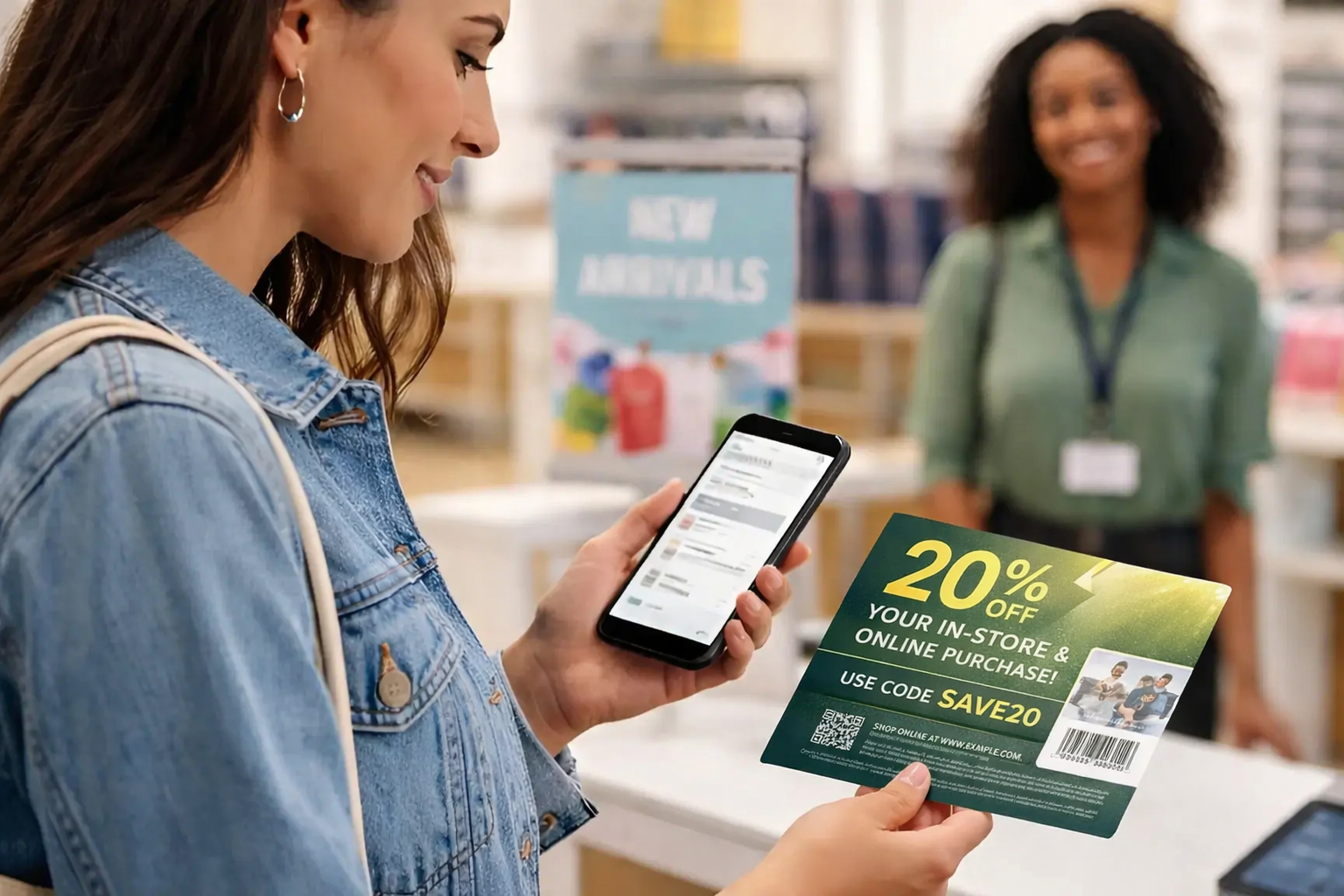
Cross-channel marketing is the practice of coordinating messaging, timing, and data across channels, such as email, direct mail, and mobile messaging, to create a unified customer experience. Instead of running isolated campaigns, it connects touchpoints into a cohesive journey that improves engagement, retention, and overall marketing performance.
Cross-Channel Marketing
Cross-channel marketing is a strategy that connects email, direct mail, and mobile messaging to improve customer engagement and retention.
- It aligns messaging and timing across channels
- It uses shared customer data for personalization
- It creates a consistent customer journey
- It drives stronger performance than isolated campaigns
What is Cross-Channel Marketing?
Cross-channel marketing is a strategy that aligns multiple marketing channels to work together as part of a single, connected customer journey. It ensures that each interaction, whether digital or physical, builds on the last, rather than operating in isolation.
The goal is not simply to use more channels. The goal is coordination—especially when connected to a broader customer loyalty strategy that drives long-term engagement and retention.
Cross-channel marketing includes:
- Coordinated messaging across email, direct mail, and SMS
- Sequenced campaigns based on customer behavior
- Shared data for personalization
- A unified customer journey across touchpoints
In a cross-channel marketing strategy, brands:
- Align messaging across email, direct mail, and SMS
- Segment communications based on customer behavior
- Use shared data to inform timing and personalization
- Create continuity across the entire customer lifecycle
For example, a customer might:
- Receive a personalized email offer
- Get a follow-up direct mail piece reinforcing that offer
- Receive a mobile message reminder before the promotion expires
Each touchpoint is connected. Each one builds on the previous interaction.
This approach contrasts with disconnected campaigns, where each channel operates independently and often delivers inconsistent or redundant messaging.
Multi Channel vs Cross Channel Marketing: What’s the Difference?
The difference between multi-channel and cross-channel marketing is coordination.
Multichannel Marketing
Multichannel marketing uses multiple channels—but they operate independently.
- Email campaigns run separately from direct mail
- Messaging may differ across channels
- Timing is not coordinated
- Data is not shared effectively
The result is fragmented customer experiences and missed opportunities for engagement.
Cross-Channel Marketing
Cross-channel marketing connects those same channels into a unified strategy.
- Messaging is consistent and complementary
- Campaigns are sequenced intentionally
- Customer data informs every touchpoint
- Performance is measured holistically
The result is a more cohesive customer journey across channels, leading to stronger engagement and better outcomes.
The reality is this: adding more channels does not improve performance. Connecting them does.
Why Does Cross-Channel Marketing Improve Customer Engagement?
Cross-channel marketing improves customer engagement because it reflects how customers actually interact with brands—across multiple touchpoints, not in silos.
When channels are coordinated, brands can:
- Reinforce messages instead of repeating them
- Reach customers in both digital and physical environments
- Respond to behavior in near real-time
- Deliver more relevant, personalized experiences
This leads to measurable impact:
- Higher response rates
- Increased repeat purchases
- Improved customer retention
- Greater customer lifetime value
For example, a retailer launching a seasonal promotion might:
- Send an initial email announcement
- Follow up with a personalized direct mail piece
- Send a mobile message reminder to customers who have not responded
This is not just repetition—it is orchestration.
Each channel plays a role in moving the customer forward.
How Do You Build a Cross-Channel Marketing Strategy?
A strong cross-channel marketing strategy starts with structure, not tools.
Identify key customer lifecycle stages:
-
First purchase
-
Onboarding
-
Engagement
-
Retention
-
Reactivation
Then define how email, direct mail, and mobile messaging support each stage.
The focus should be on momentum—what moves a customer from one action or relationship stage to the next.
Use this how-to guide to multi-channel marketing to help map your customer journey
2. Align Messaging and Timing
Consistency matters, but so does sequencing.
Instead of sending the same message across all channels at once:
Each channel should have a defined role within the campaign.
3. Use Data to Drive Personalization
Cross-channel personalization depends on shared customer data.
This includes:
- Purchase history
- Engagement behavior
- Channel preferences
- Lifecycle stage
The goal is to ensure that each touchpoint reflects what is already known about the customer—not starting from zero each time.
4. Measure Performance Holistically
One of the biggest mistakes is measuring channels in isolation.
Instead, evaluate:
- Combined campaign performance
- Incremental lift across channels
- Customer-level outcomes (retention, lifetime value)
This provides a more accurate view of what is driving results.
What Does Cross-Channel Marketing Look Like in Practice?
Cross-channel marketing is most effective when campaigns are intentionally coordinated across channels—not executed in isolation.
A strong example comes from Baesman’s work with Shoe Carnival, where the focus was on improving campaign performance through better alignment across marketing channels.
Rather than running disconnected promotions, the approach centered on:
- Coordinating messaging across email, direct mail, and mobile messaging
- Aligning campaign timing to reinforce key promotional moments
- Using customer data to guide targeting and segmentation
This created a more consistent and connected customer experience.
Instead of receiving unrelated messages across channels, customers experienced a unified campaign—where each touchpoint reinforced the same offer and moved them closer to purchase.
The impact is not just better messaging. It is better performance.
When campaigns are coordinated, brands can drive higher engagement, stronger response rates, and more efficient marketing spend.
Example: Lifecycle-Based Campaign Orchestration
This same approach applies across the customer lifecycle:
- Email introduces a promotion or product drop
- Direct mail reinforces the offer with a tangible, high-impact touchpoint
- Mobile messaging provides a timely reminder to drive action
Each channel plays a defined role.
Together, they form a coordinated marketing campaign—not a collection of disconnected efforts.
Where Baesman Fits
The challenge for most brands is not access to channels. It is orchestration.
At Baesman, this approach is foundational:
- Connecting customer data to campaign execution
- Aligning email, direct mail, and mobile messaging within a unified strategy
- Executing campaigns across both digital and physical environments
- Measuring performance across the full customer journey
This is what enables true cross-channel marketing—not just multi-channel activity.
This integrated execution model reduces fragmentation and improves speed, consistency, and measurable impact across campaigns.
What Are the Common Challenges in Cross-Channel Marketing?
The biggest challenge in cross-channel marketing is not channel selection. It is coordination.
Many brands already use email, direct mail, and mobile messaging—but struggle to connect them into a cohesive strategy. The result is fragmented campaigns and inconsistent customer experiences.
Common challenges include:
- Siloed customer data:
Data lives in separate systems, limiting visibility into the full customer journey.
- Disconnected campaign execution:
Teams plan and execute campaigns independently, leading to inconsistent messaging and timing.
- Lack of clear channel roles:
Without defined roles, channels compete instead of complementing each other.
- Difficulty measuring performance across channels
Many brands evaluate email, direct mail, and SMS separately—missing the full impact of coordinated campaigns.
The reality is this: cross-channel marketing requires more than access to multiple channels. It requires alignment across strategy, data, and execution.
Brands that solve for this see stronger engagement, more efficient campaigns, and better long-term customer value.
FAQ: Cross-Channel Marketing
Answer 3–5 related questions in short, clear responses.
What is cross-channel marketing?
Cross-channel marketing is a strategy that connects messaging, timing, and data across channels like email, direct mail, and mobile messaging. It creates a unified customer experience rather than running separate, disconnected campaigns.
How is cross-channel marketing different from multichannel marketing?
Multichannel marketing uses multiple channels independently, while cross-channel marketing connects them. The difference is coordination. Cross-channel strategies align messaging and timing to create a cohesive customer journey.
What is an example of cross-channel marketing?
Cross-channel marketing includes coordinated campaigns across email, direct mail, and SMS. For example, a brand may send an email offer, reinforce it with direct mail, and follow up with a mobile message reminder to encourage a purchase or offer redemption.
What channels are used in cross-channel marketing?
Common channels include email, direct mail, and mobile messaging. The focus is not on the number of channels, but on how effectively they are coordinated to support the customer journey.
Why is cross-channel marketing important?
It improves customer engagement, retention, and campaign performance by delivering consistent and relevant experiences. Coordinated campaigns are more effective than isolated efforts.
How do you measure cross-channel marketing success?
Success is measured by overall campaign performance, not individual channel metrics. Key indicators include response rates, repeat purchases, customer retention, and lifetime value.
Final Takeaway
Cross-channel marketing is not about adding more channels. It is about creating a connection between them.
When email, direct mail, and mobile messaging are aligned through shared data and coordinated execution, marketing becomes more consistent, more relevant, and more effective. The result is not just better campaigns—but stronger customer relationships and more sustainable growth.
Cross-channel marketing is only effective when strategy, data, and execution are aligned.
If your campaigns are running across email, direct mail, and mobile messaging—but not fully connected—there is likely untapped performance.
Explore Cross-Channel Marketing Services
Explore how Baesman supports cross-channel marketing through customer loyalty, lifecycle strategy, and coordinated campaign execution.



















.svg)