
-
Customer Strategy Services

Customer Analytics & Insights
Turn customer data into clear insights that improve targeting, campaign performance, and measurable growth.

Loyalty Program Design & Management
Build and manage loyalty programs that increase engagement, retention, and customer lifetime value.

CRM Channel Marketing & Management
Coordinate direct mail, email, and SMS strategies that reach the right customers and prove ROI.

Customer Lifecycle Marketing & Journey Mapping
Design connected journeys that move customers from acquisition to retention and repeat purchase.
Print & Marketing Execution

Direct Mail
Execute personalized direct mail campaigns that improve targeting, response rates, and measurable marketing ROI.

Email & SMS Marketing
Deliver timely, data-driven email and SMS campaigns that increase engagement, conversion, and customer retention.

In-Store Signage & All Things Print
Produce and deliver on-brand print, signage, and materials on time across every location.

Web-to-Print
Give teams one platform to order, customize, and control branded materials at scale.

Kitting & Fulfillment
Simplify complex distribution with accurate kitting, inventory control, and on-time delivery.
Branded Merchandise

Promotional Products & Branded Apparel
Curated, brand-right merchandise for campaigns, events, customer engagement, and everyday brand visibility.

Online Company Stores
Branded online stores that simplify ordering, inventory management and distribution across teams and locations.

Custom Kitting & Fulfillment
Custom kit assembly, warehousing, and reliable fulfillment for launches, events, employee programs, and customer campaigns.

Programs Built Around Your Goals
Brand-right merchandise solutions tailored to your audience, objectives, timeline and budget—from product selection through fulfillment.
-
-
-
.svg)
Why Baesman?
We combine data-driven strategy, seamless execution, and personalized support to help brands build more profitable customer relationships.

Data Security & Trust Center
See how Baesman protects customer data with secure processes, compliance standards, and a commitment to transparency.

Awards
Explore the recognition that reflects Baesman’s commitment to innovation, quality, service, and results.

Partners
Discover the technology and strategic partnerships that help Baesman deliver smarter, more connected marketing.

Careers
Join a team that values collaboration, growth, and doing the right thing for clients, teammates, and each other.




4 min read

Customer loyalty isn’t built by chance—it’s built intentionally through a deep understanding of customer behavior, preferences, and purchasing patterns. The brands that consistently outperform their competitors aren’t simply running more promotions; they’re using data to create relevant, timely, and personalized experiences that strengthen long-term relationships.
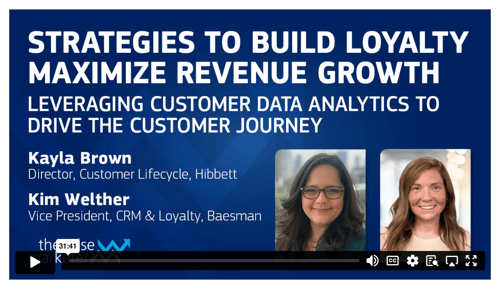
In a recent webinar hosted by The Wise Marketer, industry leaders from Hibbett and Baesman shared how a data-first strategy improved retention, increased loyalty engagement, and drove measurable revenue growth. The overarching message was clear: loyalty is not a one-time initiative—it’s an ongoing growth system that requires disciplined measurement and continuous optimization.
Below are the core strategies brands can use to build stronger loyalty programs and maximize long-term revenue.
Click here to watch the recording
Why Customer Loyalty Starts with Data
If your goal is to increase customer retention, grow lifetime value, and improve loyalty performance, everything begins with unified and trusted customer data. Most organizations already collect vast amounts of data, but the challenge lies in connecting it across platforms in a way that supports meaningful action.
Without integration, marketing becomes fragmented. Messaging may be personalized in one channel but disconnected in another. Offers may not reflect actual purchase history. Customers feel the inconsistency.
Create a Single Customer View
A single customer view connects transactional data, loyalty activity, digital engagement, and channel preferences into one unified profile. This includes:
- In-store and eCommerce transactions
- Loyalty enrollment and reward activity
- Email and SMS engagement
- App and push notification behavior
- Channel and shopping preferences
When this data is centralized, brands can:
- Segment more accurately
- Identify at-risk customers earlier
- Personalize offers based on real behavior
- Align messaging across channels
This foundation allows marketing teams to move from broad campaigns to structured lifecycle journeys that feel relevant and timely to each customer.
Turn Insights into Action: Measure What Matters
Data alone does not drive growth—consistent measurement and action do. High-performing brands establish a clear set of KPIs that monitor both customer growth and retention health over time.
Key loyalty and retention metrics include:
- Retention rate
- One-and-done rate
- Reward redemption rate
- Loyalty enrollment growth
- Member vs. non-member sales contribution
- Customer lifetime value (CLV)
Tracking these metrics weekly, monthly, and quarterly enables brands to spot trends before they become problems. For example, enrollment growth without redemption growth may indicate weak engagement. A spike in one-and-done customers may signal onboarding issues. Separating growth metrics from retention metrics provides clarity and prevents reactive strategy shifts.
Loyalty programs perform best when they are treated as evolving systems rather than static initiatives.
Building Personalized Customer Journeys
Once data is unified and KPIs are defined, activation becomes the priority. Personalization should be intentional and measurable, not random experimentation.
Many brands begin testing in email because it offers controlled segmentation, lower cost, and faster optimization cycles. After gathering insights over a 60–90 day test period, successful strategies can expand into:
- SMS
- Push notifications
- Direct mail
- Paid media
However, personalization goes beyond channel selection. It also requires understanding how customers prefer to shop. Some segments are store-first shoppers. Others are digitally native. Segmenting by shopping behavior—not just demographics—improves conversion rates while reducing wasted spend.
The goal is to align message, offer, and channel preference into one cohesive experience.

Loyalty Program Optimization Is Never “Done”
One of the most important takeaways from the webinar was that loyalty programs require ongoing refinement. Even high-performing programs benefit from continuous testing and optimization.
At Hibbett, enhancements included:
- Introducing tier structures
- Adjusting reward thresholds
- Testing accelerated earning promotions
- Refining program messaging
- Differentiating tier benefits
Each adjustment was carefully measured for incremental impact. Over time, loyalty members drove a significant portion of total sales—but that growth was achieved through disciplined iteration, not a single launch moment.
Brands must continually evaluate enrollment trends, redemption behavior, and incremental lift to understand the true financial impact of their programs. Even small changes in reward timing or communication strategy can meaningfully influence engagement.
Balancing Growth and Retention
A common mistake brands make is overcorrecting when performance shifts. If retention dips, all focus moves to reactivation. If acquisition slows, budgets shift entirely toward prospecting.
A more sustainable approach is to monitor growth and retention independently. This clarity allows brands to address the real issue without destabilizing overall performance. Healthy revenue growth depends on both acquiring new customers and maintaining engagement with existing ones.
Consistent measurement prevents reactive decision-making and supports long-term stability.
A Smarter Reactivation Strategy in Action
When retention indicators showed early signs of decline, Hibbett implemented a segmented reactivation strategy rather than deploying a blanket discount. Customers were grouped by time since last purchase, and each segment received a tailored offer based on likelihood to return.
To accurately measure impact, the team:
- Excluded those customers from overlapping promotions
- Used holdout groups to measure incrementality
- Evaluated performance beyond immediate redemptions
The results extended beyond short-term sales lifts. The campaign increased traffic, improved conversion rates, and strengthened long-term purchasing behavior over the next 6–12 months. Measuring lifetime value impact—not just coupon usage—provided a more accurate picture of success.
Proving Loyalty ROI to Leadership
Securing executive buy-in requires translating engagement into revenue impact. Marketing leaders must clearly demonstrate how loyalty contributes to overall business growth.
The most persuasive indicators include:
- Percentage of total sales from loyalty members
- Purchase frequency comparison (members vs. non-members)
- Incremental revenue from targeted campaigns
- Long-term lifetime value growth
When leadership sees that loyalty members shop more frequently and contribute a disproportionate share of revenue, loyalty shifts from being viewed as a marketing expense to a strategic growth driver.
Frequently Asked Questions
What is the first step to improving customer loyalty?
The first step is building a unified, accurate single customer view. Without connected data across transactions, engagement channels, and loyalty activity, personalization and lifecycle marketing efforts will be fragmented and less effective.
What metrics matter most in a loyalty program?
The most important metrics include:
- Retention rate
- Reward redemption rate
- Enrollment growth
- Member revenue contribution
- Customer lifetime value
Tracking these consistently allows brands to identify engagement gaps and optimize accordingly.
How often should a loyalty program be updated?
Loyalty programs should be reviewed continuously, with formal performance evaluations conducted at least quarterly. Optimization—such as adjusting rewards, testing offers, or refining messaging—should be ongoing based on data insights.
How do you measure if a loyalty campaign truly worked?
The most reliable way is through incrementality testing. Using holdout groups helps determine whether customers would have purchased anyway or if the campaign drove new behavior. Long-term purchase frequency and lifetime value should also be evaluated, not just immediate redemptions.
